Why the Maltese Language of Arabic Origin Survived While Islam in Malta Disappeared
At first glance, Malta looks like a typical Catholic country in the Mediterranean – churches on every corner, processions, feasts of patron saints. When you look more closely, however, you encounter something that sets it apart from the rest of Europe: most of its inhabitants still speak Maltese, a language of Semitic (Arabic) origin.
How is it possible that the language of the Arab conquerors survived for centuries in Malta, while their faith – Islam in Malta – almost completely disappeared? And why did Arabic die out in Sicily or Spain, but not on this small island in the middle of the Mediterranean?
In this article, we will look at how the Maltese dialect of Arabic became the distinct language known as Maltese, how the re-Catholicisation of the islands unfolded – and what this paradox (“speaking Arabic, believing Catholic”) tells us about Malta’s history and identity.
A Mediterranean Anomaly: The Maltese Language – a Semitic Language in a Catholic Country
Within Europe, Malta is a unique case – a predominantly Catholic country whose inhabitants still speak a language of Semitic (Arabic) origin. Although the islands are geographically closer to Sicily than to North Africa, the language the Maltese use is ultimately derived from the North African Arabic spoken around 1000 AD. Most Maltese, however, do not associate this origin with a contemporary Arab identity – they experience their language as something distinct and purely Maltese.
This fact stands in sharp contrast with other Mediterranean regions where Arabic once predominated (such as Sicily or the Iberian Peninsula). There, after the return of Christian rule, a linguistic shift took place and the Arabic dialects disappeared, whereas in Malta the local population preserved a language of Arab origin. At the same time, the faith of the Arab conquerors – Islam – did not take lasting root in Malta, and for centuries the island has presented itself as a stronghold of Roman Catholicism.
This paradox (Arabic language vs Catholic faith) makes Malta a fascinating case for linguists, historians and cultural anthropologists. Linguistically, Maltese is considered the only direct, living descendant of the former Sicilian Arabic – and it is also the only Semitic language written in the Latin alphabet and officially recognised within the EU.
Religiously, Malta is almost homogeneously Catholic. The Islamisation that occurred during the period of Arab rule was completely reversed after the reconquest of the islands by Christians. The Maltese case therefore makes it possible to explore how a linguistic heritage can endure even after the original religious identity of a population has completely changed.
Maltese culture still bears traces of this seemingly closed Arab chapter – not only in the language, but also in place names, surnames, architecture and everyday customs.
Malta’s Arab Era (870–1091): Its Impact on Language, Culture and Faith
The Arab chapter of Maltese history began in 870, when the armies of the Aghlabid dynasty from Ifriqiya (present-day Tunisia) conquered Malta, then part of the Byzantine Empire. According to contemporary chronicles, the campaign was particularly brutal and the islands were left devastated and almost depopulated. New life was breathed into them only by a colonisation wave of Muslims from Sicily in 1048–49, thanks to which Malta was transformed from a deserted territory back into a flourishing part of the Islamic world.
In other words – after 870 the original Christian population either disappeared completely, or merged with the newly arrived Arab settlers to such an extent that earlier pre-Arab languages (such as Latin, Greek or Punic) have left no clear traces in modern Maltese.
The Islamisation and Arabisation of Malta took place mainly in the 11th century. Around 1048, a wave of Arabic-speaking settlers arrived from Sicily. They brought with them their language (an Arabic dialect close to Tunisian Arabic), their religion (Sunni Islam) and visible imprints on everyday life – in architecture, food, agriculture and decoration.
It was during this period that most of today’s place names in Malta and Gozo emerged – many villages begin with the element raħal/Ħal (in Arabic “village”), for example: Ħal Qormi, Raħal Ġdid, Ħal Tarxien, Ħal Luqa. Common surnames such as Borg, Cassar, Farruġia, Mifsud and Zammit also have Arabic roots.
In terms of language and culture, Malta became part of the western Islamic world – the local dialect of Arabic was very close to the speech of Sicily and the Maghreb (the region of North Africa) around the year 1000.
The islands also benefited economically from Arab administration. New irrigation technologies were introduced (such as the water wheel sienja), terraced agriculture, the cultivation of citrus fruits and cotton, and efficient irrigation of dry fields.
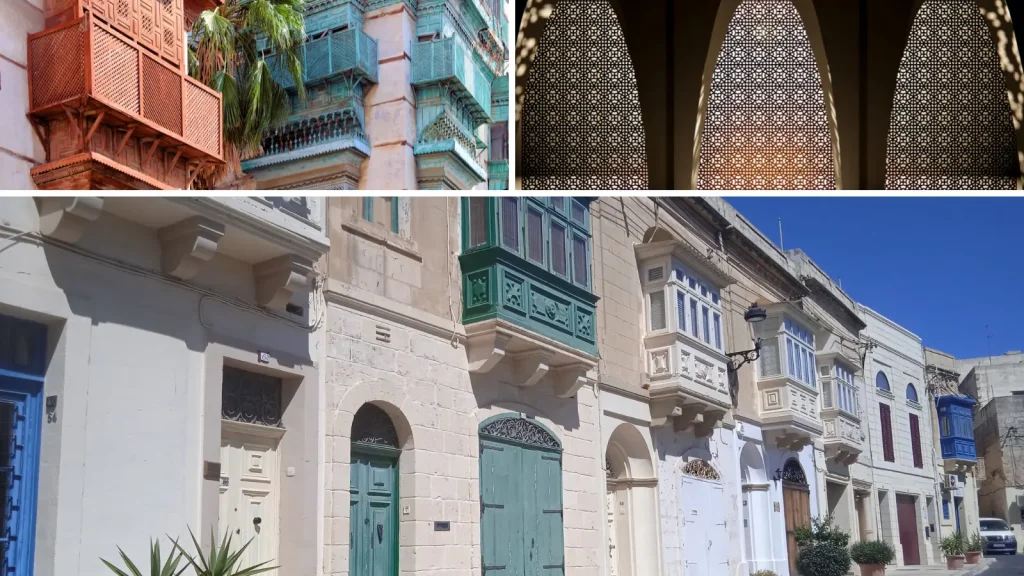
Local cuisine and crafts were enriched as well: the Arabs brought almonds, figs and spices and taught the inhabitants to make sweet pastries. Elements of Islamic architecture penetrated into building traditions, for example the characteristic wooden balconies (muxrabija), derived from the Arabic mashrabiya.
From a religious perspective, the 200 years of Arab rule led to an almost complete Islamisation of the islands. The original Christians, if any remained, largely converted to Islam and adopted Arab culture. Malta became part of the Sicilian Emirate and later of the Fatimid Caliphate.
The main mosque probably stood in Mdina (the urban centre at the time), and the island came under sharia law. Archaeological finds show that in the 10th–11th centuries Malta was not a deserted periphery, but a flourishing region – pottery from this period closely resembles finds from Sicily, indicating intense trade.
The island had a strategic location between Tunisia and Sicily and functioned as a base on sea routes – garrisons were stationed there to protect ships from pirates. The Muslim community in Malta clearly grew and strengthened.
In summary: by the end of the 11th century Malta was fully integrated into the Arab Islamic world. The population spoke Arabic, formally professed Islam and shared both the material and spiritual culture of the Muslim Mediterranean.
This situation, however, was not destined to last – a Christian reconquest of the islands was on the horizon, radically transforming their religious landscape. The linguistic legacy of the Arab era, however, did not disappear completely.
From Arabic to the Maltese Language: When and How Did the Split Happen?
Maltese (il-Malti) developed from a dialect of Arabic that took root on the islands during Arab rule – specifically from a Sicilian-Arabic variety close to Tunisian Arabic.
The separation of Maltese from its parent Arabic took place gradually after the reconquest of Malta by the Christian Normans. Once the local Muslim community found itself isolated from the rest of the Islamic world, the language began to evolve independently. From around the 13th century, Maltese no longer had direct contact with Classical Arabic or with the emerging standard written Arabic, and instead followed its own path among the island’s inhabitants. From the 13th century onwards, Maltese thus functioned as the spoken language of the Christian populace, but a written tradition and literary status did not develop until several centuries later.
The key turning point was that after most Muslims had left or converted to Christianity (see below), Maltese Arabic became the language of a Christian community. It survived as the everyday speech of ordinary people, even though it was no longer prestigious or official.
During the late Middle Ages, Maltese underwent significant changes: its phonetics, morphology and syntax were simplified in comparison with Classical Arabic, and at the same time it absorbed large numbers of words from Romance languages. Norman and later Sicilian-Italian rule brought centuries of influence from Sicilian and Italian – Maltese borrowed vocabulary for administration, religion, crafts and everyday life.
The earliest surviving written documents from Malta (14th–16th centuries), however, are not in Maltese but in Latin or Sicilian. Maltese remained a spoken language; Arabic script was no longer used (the islands were Christian), and the tradition of writing Maltese in the Latin alphabet was only just emerging. As a result, we have very few direct records of the spoken language of the inhabitants from the 13th–15th centuries.
In isolation from the Arab world, Maltese gradually changed so much that it now differs markedly from modern Arabic dialects. Speakers from some North African countries (such as Tunisia or Libya) may understand it to some extent, because of the shared Semitic base. The reverse, however, is usually more difficult – most Maltese do not learn Arabic, and modern forms of Arabic tend to be incomprehensible to them.
From a linguistic viewpoint, however, it is clear that the basic grammatical system of Maltese has remained Semitic: for example, verb forms, personal pronouns and basic numerals correspond directly to Classical Arabic or to modern Tunisian speech.
Modern philology confirms that Maltese did indeed develop from one of the Sicilian-Arabic dialects over the last 800 years or so, with gradual Latinisation adding a heavy layer of Romance vocabulary.
Whereas in Sicily itself only a few hundred Arabic loanwords survive in an otherwise entirely Romance language (Sicilian), Malta has preserved an unbroken continuity of a living Semitic language right up to the present day.
As late as the 16th and 17th centuries, foreign travellers described Maltese as “corrupted Arabic”. Only in the course of the 18th and 19th centuries did it become a fully fledged written language with its own orthography and literature. In the 18th century, the Maltese scholar Mikiel Anton Vassalli wrote the first grammar of Maltese and began advocating for its equality with other languages. Maltese finally received full recognition in the 20th century – it became an official language (alongside English) and is now used in schools, public administration and the media.
The Disappearance of Islam in Malta: Normans, Conversion and Re-Catholicisation
While the language of the Arab conquerors put down permanent roots in Malta, their Islamic faith receded after power passed into Christian hands. The process of turning the islands back to Christianity took place in several stages.
The Normans from Sicily first arrived in Malta around 1091, led by Count Roger I of Hauteville. Roger was content to accept capitulation and an annual tribute from the local Arab governor (emir). The Maltese Arabs recognised Roger as their formal feudal overlord, but their internal administration and religion remained untouched. The Normans were pragmatic – they kept the Arab bureaucracy running and did not immediately push for religious change. After Roger’s departure, the Muslim community in Malta continued to flourish: demographically and economically it still dominated the islands and merely paid a subordination tax (tribute) to the Normans.
In 1122, however, there was an uprising of Muslims against Norman rule and the situation escalated. In 1127, Roger’s son, King Roger II of Sicily, launched a decisive intervention – he reconquered Malta, crushed the revolt and established firm Christian rule on the islands. This moment can be regarded as the real end of Arab political power in Malta.
A gradual process of cultural and religious transformation followed. Links with Sicily were strengthened, Christian commanders were installed and missionary activity was launched. Christianity began to spread among the population. Even so, Islam did not vanish from Malta overnight. In the 12th and early 13th centuries, coexistence between Christians and Muslims on the islands was relatively peaceful and the two communities existed side by side.
The decisive turning point came under Emperor Frederick II Hohenstaufen. In Sicily he faced prolonged rebellions by local Muslims and feared that the Muslims of Malta might support the insurgents. In 1224, the emperor therefore sent an armed expedition to Malta with the aim of pre-emptively eliminating the Muslim population. This intervention marked the beginning of the end of Islam in Malta. After 1224, a period of gradual conversion or deportation of Muslims began. Those who did not leave probably accepted baptism.
By 1270, Malta had been fully integrated into church structures – a local Roman Catholic diocese was established. The following centuries (under dynasties from Aragon, Castile and later the Knights Hospitaller) consolidated the island’s Catholic identity.
It is striking that the re-Catholicisation of Malta was rapid and virtually complete, whereas linguistic Romanisation remained incomplete. The difference lay in the fact that the change of religion was imposed from above as a question of loyalty, while language developed from below – in people’s everyday communication – and did not pose a political threat to the new rulers. I will explain this in more detail in the next section.
Why the Language Survived – and the Faith Did Not: Key Factors
When we ask why Maltese, as an Arabic-derived dialect, survived for centuries while Islam as a religion disappeared, we need to consider the interplay of several cultural, psychological and power-related factors:
1. Continuity of Population vs Population Replacement
A crucial role was played by who remained on the islands after they were conquered by Christians. In Malta, the dominant pattern was conversion of the original Muslims to Christianity, rather than their extermination or replacement by foreigners. Many Muslim families accepted baptism so that they could remain on their lands instead of going into exile. As a result, most of the population continued to speak their mother tongue fluently – they simply no longer professed Islam.
2. Lack of Top-Down Linguistic Assimilation
The new Christian rulers (the Normans, later the Spanish Aragonese and the Knights Hospitaller) did not impose a foreign language on the islanders in their everyday lives. The official and liturgical languages were Latin, Greek or Sicilian, but these were used mainly in administration and the Church. In the villages and within families, ordinary people continued to speak their own language – which only later came to be called Maltese.
The ruling elites often looked down on the local language, but they did not undertake systematic efforts to suppress it. The Knights of St John (ruling from 1530 to 1798), who were mainly foreigners (French, Spanish, Italian), used Italian or French in their administration, but the language of the people remained outside their sphere of interest.
For a long time Malta had no public education system, and in the 18th century illiteracy exceeded 90% – meaning there were no schools that could have taught children another language. This policy of benign neglect allowed Maltese to be passed on orally from generation to generation without interference from above.
3. Psychologically Separating Language from Religion
For the inhabitants of Malta, changing their faith was a matter of survival, because religion represented a choice of loyalty – whom do I belong to, which authority do I recognise? Language, by contrast, served primarily as a tool of everyday communication.
When a Muslim converted to Christianity, they thus signalled belonging to the community of conquerors – often out of existential necessity. At home, however, they could continue to speak as their mother had taught them. Language in itself was not perceived as a threat to the political order.
The Norman and later administrations apparently tolerated the fact that the common people spoke “Saracen” (i.e. Arabic – the contemporary label for the language of Muslims), as long as they loyally attended church. Maltese would only have been eradicated if the island had been completely resettled by outsiders, or if the original population had been confined to ghettos. Neither of these scenarios occurred.
4. Social and Demographic Influences
Although new settlers did arrive in Malta after the Christian takeover (such as colonists from Sicily or soldiers and sailors of the Knights), they never outnumbered the original population. Many assimilated and adopted the local speech (especially women from the common people whom foreigners married and who passed the language on to their children). The small size and isolation of the islands also helped maintain a unified language – most Maltese remained in daily contact mainly with each other. The influx of Italians in the time of the Knights left a strong imprint, but did not lead to a switch to Italian as the general lingua franca. Until the 19th century, Maltese were largely monolingual – they spoke Maltese only. Bilingualism (Maltese and English) spread only in the modern era.
In short, the language survived because it could “live in the background” – it served people in private and community life, where central power intervened only minimally. The faith did not survive, because it was politically decisive – anyone who remained a Muslim would have been seen as a potential rebel against the Christian rulers. Once the Muslim community disappeared, the motivation to suppress linguistic difference also faded. Maltese ceased to be a symbol of an enemy faith and became simply the speech of Christian peasants and sailors.
For comparison: the return of Christian rule in Sicily followed a different pattern. The local Muslim population was either driven into exile or survived for several generations as a distinct minority (the Moriscos), which the Christian kingdom eventually also eliminated or expelled. Sicilian Arabic thus had no chance to survive among the wider population – it disappeared by the 14th century. On the Iberian Peninsula, the Moriscos (Muslims converted to Christianity) were forced to adopt Castilian or Catalan and were expelled from the country in the 17th century, which meant the final end of Andalusi Arabic.
Malta’s Post-Arab Catholic Identity: Speaking “Arabic”, Believing “Catholic”
After the expulsion of Muslims in the 13th century, Malta once again became a firmly Catholic country, but the legacy of the Arab era did not completely disappear from its mentality and culture. From the late Middle Ages onwards, Maltese identity took shape as a remarkable blend. The inhabitants were ardently loyal to the Western (Latin) Christian civilisation and at the same time, in private, used a native language derived from the speech of former Muslim conquerors.
This duality undoubtedly astonished outsiders even then (as we quoted earlier: “they are Christians but they speak Saracen”). For the Maltese themselves, however, it was everyday reality. How did they cope with it? For centuries the Maltese tended to emphasise their European and Catholic belonging, while their Arab past was perceived ambivalently – often downplayed, ignored or outright denied. In other words, Maltese collective memory treated the Arab epoch as a dark period that had to be overcome by returning to the true faith.
Language seemed to stand outside this moral evaluation. Although Maltese was the most tangible remnant of Islam on the islands, Maltese people gradually ceased to associate it with Islam. They began to see it as their national language – Malti – unique and distinct from Arabic. As early as the 15th and 16th centuries we find native terms such as lingua maltensi, lingua melitea (“the Maltese language”). While foreigners at the time referred to it, with allusion to its Semitic roots, as an “African tongue” or “corrupted Arabic”, for the Maltese it became the language of their own identity.
Only modern linguistics in the 20th century confirmed beyond doubt that Maltese descends from medieval Arabic. In the wider public consciousness, however, the language is not seen as a “foreign legacy”, but as a national treasure. It is telling that many Maltese still struggle to fully accept the Arab and Muslim component of their history. For many, it is difficult to come to terms with the fact that their distant ancestors were Arab Muslims – and yet the language they speak has a fundamentally Semitic (Arabic) origin. It is enough to look at the basic vocabulary: numerals, personal pronouns, common words for food or kinship – all of these have clear parallels in Arabic. The same applies to most place names and surnames. Maltese grammar itself remains “Arabic” in essence (albeit simplified).
In everyday life, however, the average Maltese does not identify particularly with the Arab world. For centuries they have defined themselves primarily through Catholic faith and Mediterranean (Italian-European) culture rather than through linguistic origin. Today’s Maltese are descendants of generations who, since the end of Arab rule, have intermarried mainly with people from Sicily and southern Italy, so their ancestry is now much more diverse and it would be inaccurate to describe them ethnically as Arabs.
How Maltese People Today View Islam, Arabic and the Maltese Language
According to the 2021 census, fewer than 4% of the population – roughly 17,000 people – identify as Muslim. By contrast, over 90% of Maltese described themselves as Catholic in the same census. The remainder consists of small minorities of other religions and people with no religious affiliation.
Maltese people are generally known as strongly conservative Catholics – Catholicism is still enshrined as the state religion in the constitution. Until 2011 it was illegal to apply for a divorce, and until 2023 it was not possible to undergo a legal abortion even in cases where pregnancy endangered the mother’s life.
In school curricula, the Arab period is studied as one of several chapters of Maltese history. The focus is mainly on material contributions – for example irrigation, architecture and language – and it is emphasised that Malta formed part of Islamic civilisation. Public awareness today, however, places greater emphasis on continuity with Europe. Local patriotism often invokes Phoenician and ancient roots (megalithic temples, Punic remains), the early Christian tradition of St Paul and heroism against the Ottoman Empire. The Arab episode tends to be presented soberly, without idealisation – sometimes even with a degree of unease.
The attitude of Maltese people towards their own language is very positive today – Maltese is an official language, a symbol of national identity and a subject of linguistic scholarship. Even so, there remains a certain distance from the contemporary Arab world. Most Maltese do not speak any other Arabic dialect than their own and tend to understand Italian or English much better.
Although linguistically Maltese belongs among the Arabic dialects, for the average Maltese person an Arab (for example a visitor from Tunisia or Libya) is a foreigner speaking a language that is hard to understand. This is the result of a long period of independent development. Maltese and North African Arabic diverged from each other from the 13th century onwards, to the point that today their speakers do not understand each other very well. Libyans or Tunisians often understand Maltese speakers better than vice versa – thanks to the shared linguistic base and fewer loanwords. Maltese pronunciation is markedly different and the language contains thousands of words borrowed from Italian, Sicilian and English.
This paradoxically deepens the psychological distance – Maltese people do not perceive their language as Arabic, because it sounds different from the modern Arabic they hear in the media. On top of that, it is written in the Latin alphabet, which visually sets it apart from Arabic script. All this reinforces the feeling that their language is unique and exclusively theirs, not a mere “branch of Arabic”.
In Conclusion: The Maltese Language as Cultural Heritage vs Faith as a Question of Loyalty
The story of Malta clearly shows that language and religion can follow very different historical paths. The Maltese language has survived dramatic changes in political regimes and religious orientations because it was deeply rooted in the population and posed no threat to the new rulers. It became a carrier of cultural memory – a living testament to an old Arab chapter, even though Malta itself evolved into a firmly Catholic society.
Islam as a religion, by contrast, was closely bound up with power and political identity. When circumstances changed (the Christian reconquest of the island), adherence to Islam became an obstacle to loyalty to the new order. Islam therefore disappeared from Malta, either through conversion or the departure of its adherents, and with it the institutions that could have transmitted it to subsequent generations.
And this raises a question for our own time: will Maltese withstand the pressure of an all-pervasive global English? Young Maltese people master both languages, but in everyday life they increasingly lean towards English – it is easier in terms of grammar, more accessible through the media and above all more useful in dealing with the world beyond Malta. Will il-Malti remain a living language – or will it gradually become merely a school subject and a national symbol?
Quick questions about Maltese, Arabic and Islam in Malta
Is Maltese actually a form of Arabic?
Maltese is a Semitic language that developed from a medieval Arabic dialect. Today it has its own identity and a large layer of Romance and English vocabulary.
When did Islam disappear from Malta?
Islam declined after the Norman takeover and later political measures under Christian rule. The process took place over time rather than overnight.
Why did Arabic survive in Malta but not in Sicily or Spain?
Malta followed a different demographic and political path. Language remained in daily life while religion changed mainly as a matter of power and loyalty.