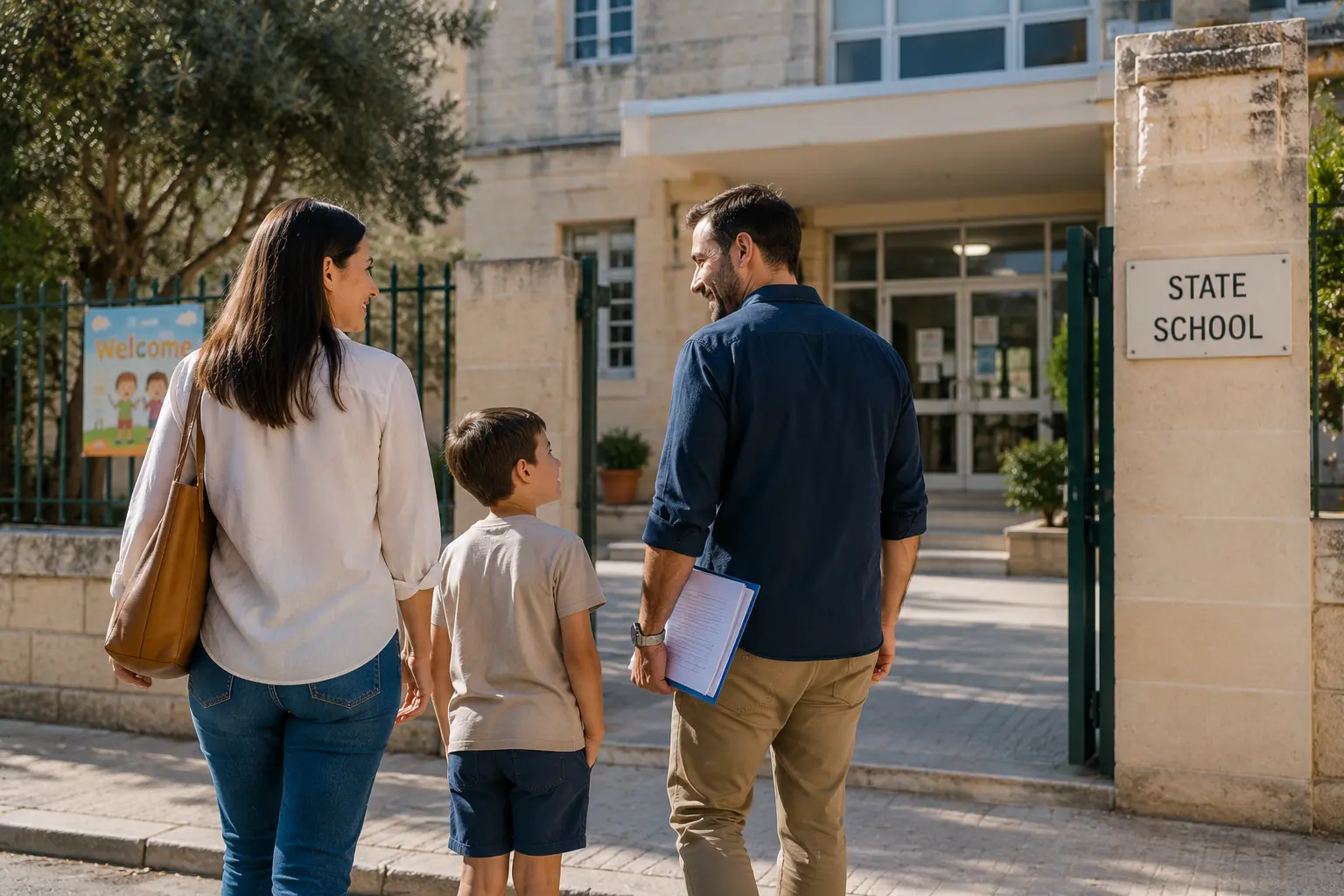
How to Enrol a Child in a Public School in Malta
Enrolling a child in a public school in Malta is an administrative process with clearly defined rules, but for families arriving from abroad it can initially feel confusing.
In this article, I guide you step by step through the process of enrolling a child in a public primary or secondary school in Malta. I explain who can apply, when and where enrolment is handled, which documents are usually required, and what happens after the application is submitted.
I deliberately do not address the immigration status of parents or the differences between EU and third-country families here. These topics are covered in a separate article. The aim of this text is to give you a clear and practical overview of how the enrolment process works.
Who Can Apply for a Place in a Public School
Public schools in Malta are intended for children of compulsory school age, which runs from 5 to 16 years. Compulsory education applies to all children who live in Malta on a long-term basis, regardless of nationality.
In Malta, there are three main types of schools: public, church, and independent (private). Each type has its own admission process. This article focuses exclusively on public schools, which are state-funded. Enrolment in church and private schools follows different procedures and is not covered here.
Although education in public schools is free of charge, schools may request small one-off contributions for certain services and materials, such as a school diary, student identification card, locker use, photocopies, or similar administrative items.
When School Enrolment Takes Place
The school year in Malta usually starts on the last Wednesday of September and ends around 26 June, although the exact dates are announced by schools each year. Enrolment in public schools is not restricted to a single application period and can also take place during the school year. In such cases, the child joins an existing class.
It is advisable to start looking into school enrolment as soon as possible after arriving in Malta. However, the application process usually cannot be completed until you can provide proof of your Maltese address, such as a rental agreement, property ownership documents, or utility bills. Public school placement is based largely on catchment areas, and children are generally assigned according to where the family permanently resides.
EU citizens can usually deal with school enrolment alongside their residence registration process with Identità Malta. Families from outside the EU are generally expected to have at least submitted the relevant residence application or be able to provide documentation confirming their immigration status.
Once your accommodation and supporting documents are in order, schools will usually help you complete the process fairly quickly.
Where to Enrol a Child in a Public School
Enrolment is usually handled through the regional College network responsible for public schools in a given area.
The entire system is based on the family’s place of residence. A child is typically assigned to a school corresponding to the area where the family lives. At primary level, this means the local catchment school; at secondary level, pupils are grouped into larger regional zones.
Parents usually:
- bring the complete set of documents to the relevant College administration,
- the application is processed there,
- and the College then informs them which school the child has been assigned to and when they are expected to start.
Formally, the system falls under state education, but in practice parents communicate directly with the College network corresponding to their place of residence, not with the Ministry for Education itself.
College Networks – Which College Covers Your Area
Malta’s public schools are divided into regional units known as College networks. Below is an indicative overview of College networks and the areas they typically cover.
- St Clare College (Sliema, St Julian’s, Gżira, Pembroke, Swieqi)
- St Ignatius College (Siġġiewi, Rabat, Mdina, Dingli, Attard)
- St Benedict College (Paola, Ħamrun, Marsa, Santa Luċija)
- St Nicholas College (Mosta, Naxxar, St Paul’s Bay, Mellieħa)
- St Thomas More College (Żejtun, Żabbar, Fgura, Marsascala, Kalkara)
- St Albert the Great College (Valletta, Floriana, Cottonera – Birgu, Senglea, Cospicua)
- St Margaret College (Cospicua, Żabbar – some areas of Cottonera)
- St George Preca College (areas around Żejtun, Marsa, Pietà, Msida, Birkirkara)
If you are unsure which College network applies to you, contact the nearest public school or the Local Council, who can direct you to the correct authority.
Documents Required for Public School Enrolment
When enrolling a child in a public school in Malta, the following documents are usually required:
- the child’s birth certificate,
- proof of identity of the child (e.g. passport),
- proof of identity of the parent or legal guardian,
- the parents’ marriage certificate,
- a court ruling or custody agreement (in cases of divorce or shared custody), or a document confirming who the child’s legal guardian is,
- proof of residence in Malta (most commonly a rental agreement),
- where applicable, school reports or certificates from the child’s previous school,
- the child’s vaccination record or immunisation history.
If the documents are issued in a language other than English or Maltese, an official translation into English is usually required.
Vaccination records are also generally expected to be in English. In my case, however, the College network accepted vaccination records issued in two different EU countries without any official translation. The names of diseases and vaccines were listed in Latin, and the school nurse was able to interpret the records without difficulty.
At the same time, it should be expected that vaccination records issued outside the EU (for example in Asia or Africa) will usually require an official English translation.
School enrolment usually involves more than just the application form itself. Parents are often asked to complete additional forms relating to the child’s health, allergies, medication, communication preferences, and consent for photographs taken during school activities. The exact paperwork may vary slightly between schools.
Schools also commonly provide a Code of Behaviour. This is not simply a list of rules for pupils. In many public schools, parents, the school, and the child are all asked to acknowledge that they understand the school’s expectations and agree to cooperate in following them.
Parents may also be asked to sign consent forms relating to educational visits and school outings. In some schools, a general consent form covers activities throughout the year, while separate forms are only required if parents wish to opt out of a particular event.
Parents are also asked to choose whether their child will attend Religion or Ethics lessons. Choosing Ethics does not automatically exclude a child from all school-related religious activities. Schools often allow parents to decide whether their child may participate in certain events, such as church services or First Holy Communion celebrations in Grade 2. If consent is not given, the child remains supervised elsewhere in the school during the activity.
What Happens After the Application Is Submitted
Parents are usually contacted by email or phone. The school then provides practical information about school organisation, uniforms, introductory meetings, and the supplies needed for classes. Information about registration for the free school transport system is also often included for families who qualify.
A child does not need to speak English or Maltese before enrolment. Schools do not treat a lack of language skills as a reason to refuse admission. Instead, once the child starts school, the focus is on helping them adapt to classroom communication, lessons, and everyday school life during the first few months.
During the school year, parents regularly receive information about their child’s progress and school performance, either through school reports or meetings with teachers. Teacher feedback is not always interpreted in the same way as in other countries. Comments that sound positive may still indicate areas for improvement, while seemingly neutral remarks can carry important meaning. I discuss this in more detail in my article about teacher feedback in Malta.
Public schools have extensive experience with children arriving from abroad. From my own experience, children are remarkably adaptable and often make new friends and absorb both languages within a few months, with English usually developing more quickly. Schools may also offer various forms of support, including language assistance and programmes such as Catch-Up Classes, which can help children catch up academically and settle into the education system.
In most European countries, school meals are a standard part of nursery and primary education. In Malta, however, state schools do not operate school canteens, and children bring their food from home. There is no central kitchen and no hot meals prepared by the school. For parents who are used to school meal systems, this is often one of the biggest practical surprises after moving to Malta.
Changing Schools Due to a Change of Residence
A change is possible, but it always depends on the availability of places and approval by the education authorities.
If a family moves during the school year, it is possible to apply for a transfer to the new catchment school, or in some cases to temporarily keep the child in the original school.
Conclusion
Enrolling a child in a public school in Malta follows a clearly defined framework and is handled primarily through the regional College network. The key is to have all documents prepared, submit the application as early as possible, and be aware that school placement is usually determined by the place of residence.
You may also find these articles useful: