Comino and the Blue Lagoon, Malta: Paradise or a Tourist Trap?
I remember my first trip to the Blue Lagoon sometime around 2008. I came here as a newly-in-love young woman with my boyfriend. We spent most of the several-hour stay in the water, leaving our belongings somewhere on the rocks. Of course, even back then there were quite a few tourists – boats were bringing groups of people, visitors were sitting on the rocks sunbathing – but the atmosphere remained relatively calm, and we left in the late afternoon with a lovely memory of beautiful swimming and a romantic place.
Since then, I have often seen photos of the Blue Lagoon online – a bay with incredibly blue water, a few boats shimmering on the surface, and just a handful of people. Those images always looked like perfect idyll. It is no surprise that Comino has become one of Malta’s biggest attractions and a favourite target for tour operators and influencers. This tiny island, with an area of just 3.5 km² and a permanent population of only a few people, offers something many associate with the idea of paradise on earth – crystal-clear sea, sunshine, and that feeling of a lost paradise where you seem to be almost alone.
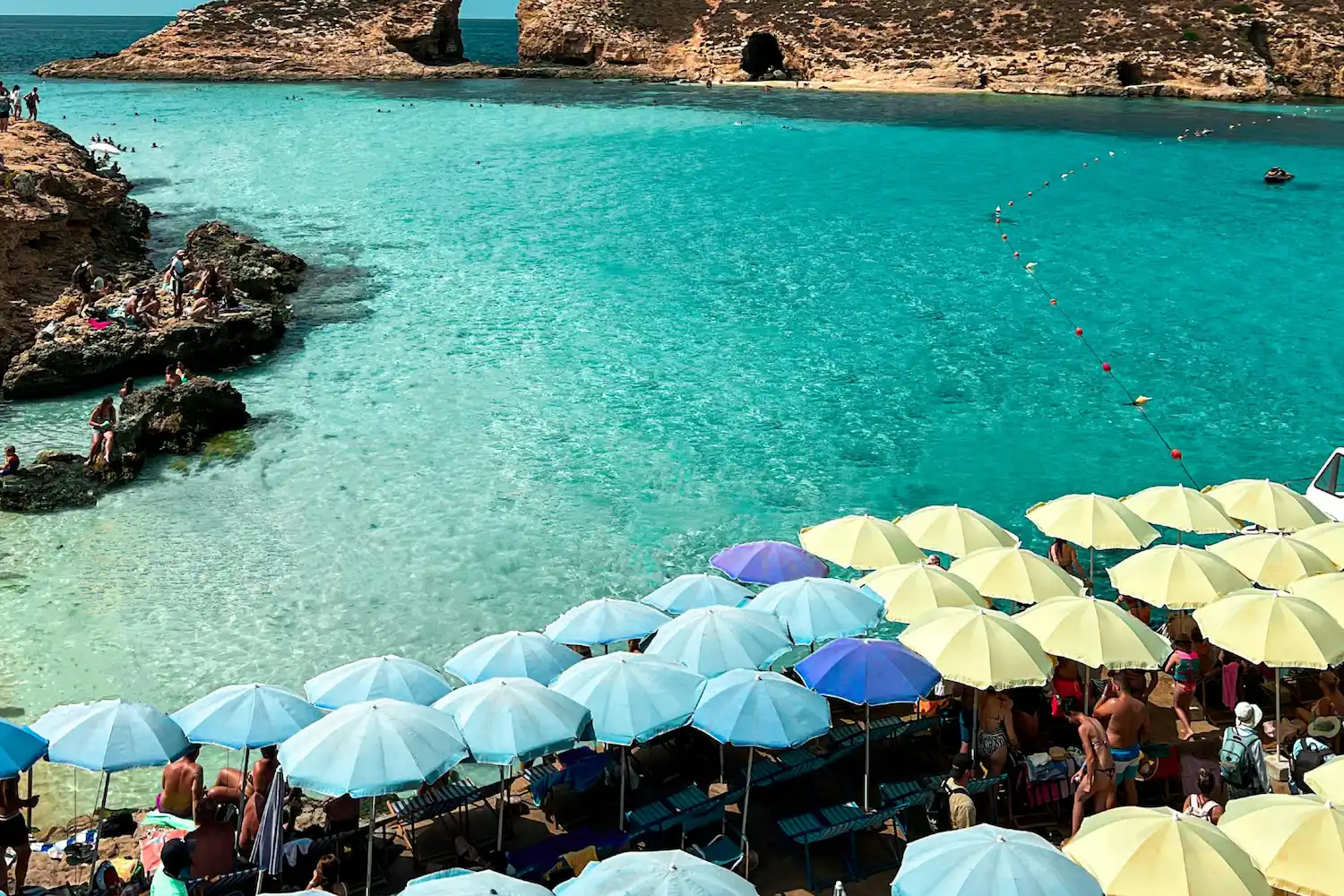
But ten years later, I realised that even paradise can have its darker side. In August 2018, we went to Comino again – this time as a family with children and a grandfather who occasionally struggles with his knees. I was looking forward to it being a special experience for him, an iconic place like it had been for my husband and me. Instead of a peaceful lagoon, however, we were greeted by a sea of people who had already occupied almost every available sunbed.
Sitting down on a towel was practically impossible. Around the sunbeds there are only narrow pathways, and where sunbeds cannot be placed, there is either sharp rock or a walkway constantly used by passing visitors. So if you have small children, are in a larger group, or simply want somewhere to put your things, there really is no other option than paying for a sunbed. I no longer remember the exact price, but I do remember being taken aback by how high it was. Looking out across the landscape, you could see one excursion boat after another anchored on the water, each unloading crowds of tourists onto the shore. Loud music blasted from speakers, clashing with music from other kiosks, the air was filled with the smell of fried food – and everywhere those famous pineapples used as drinking cups.
The swimming itself was far from romantic – too many people packed too close together. The feeling I had taken away from my first visit simply did not happen at all this time. Instead, it was more a sense of disappointment at how many people were there with us, and the inability to sit down anywhere without paying.
Mass tourism on Comino: pressure on nature, public space, and local residents
My personal experience from 2018 describes a period when access to Comino was practically unregulated. Today, in 2025–2026, it is clear that we were far from the only ones to have such an experience. Comino has quite literally become a victim of its own beauty. During the high season, according to articles in Times of Malta, around 10,000 people visit the island each day. For such a small island, this represents an enormous burden. The lagoon, which looks like a deserted bay in photos, is in reality bursting at the seams in summer. Excursion boats arrive from Malta at regular intervals, bringing tourists from morning until evening and creating an almost endless flow.
After years of criticism from local residents, environmentalists, and tourists themselves, the first responses began to appear. People increasingly complained that Comino was no longer the peaceful paradise it once was. Photos of an overcrowded Blue Lagoon circulated on social media – sunbeds and umbrellas packed tightly together like in an exhibition hall, and crowds of visitors squeezing onto the tiny beach and surrounding paths. Many tourists who came for idyllic nature were disappointed by the reality – instead of calm and beauty, they found an overcrowded, noisy, and heavily commercialised island. As a result, calls for change grew louder.
There were also open protests against the occupation of public space by private operators. In the summer of 2022, for example, a group of activists from Moviment Graffitti organised a symbolic action on Comino – early in the morning at the Blue Lagoon, they personally removed dozens of empty sunbeds and umbrellas that operators had set up before visitors arrived, clearing them from the beach. With this protest, the activists wanted to show that access to the sea should remain free and should not be conditional on paying for a sunbed. They pointed out that the coastline is public space and should remain freely accessible. According to them, sunbeds and umbrellas should only be set up on request and in limited numbers, so that they never occupy most of the beach.
At the same time, they pointed out that the Blue Lagoon and its surroundings had effectively been taken over by commercial interests. Numerous kiosks and food stalls had appeared, while large excursion boats continued bringing thousands of visitors every day. The protest highlighted something that had been discussed quietly for years – that the Blue Lagoon simply could not function without proper regulation.
How Malta Is Managing Visitor Numbers on Comino
And indeed – in recent years, Maltese authorities have begun taking the first steps to improve the situation. Their aim is to protect local nature while also restoring the visitor experience people expect from this place. Since May 2025, a new online reservation system for visitors to the Blue Lagoon has been launched. Anyone who wants to disembark in the Blue Lagoon area – whether arriving privately or by boat – must now book free entry in advance via the official website. After registration, visitors receive a QR code to be shown at the entrance.
The reservation system operates on time slots and limits the number of people in the Blue Lagoon area to around 4,000 at any one time. By comparison, during summer peaks in previous years, up to around 10,000 visitors could be present in the lagoon at the same time. Entry without a prior reservation is no longer permitted and may be subject to a fine.
The Maltese government is trying to strike a balance. On the one hand, it does not want to lose one of the country’s biggest tourist attractions. On the other, it has been clear for several years that the Blue Lagoon reaches its limits during the summer season. Alongside the reservation system, the authorities have gradually introduced additional measures, including better-defined swimming zones, regular cleaning, improved sanitary facilities, and stricter enforcement of the rules.
Most of these measures have been introduced as part of the Team Blue Lagoon project. The authorities continue to monitor how the system works in practice, and it remains in place throughout the 2026 season.
Comino is also part of the European Natura 2000 protected network, which means strict nature protection rules apply. The new regulations should help preserve its sensitive ecosystem while allowing visitors to experience the island as it appears in those beautiful photographs – quiet, clean, and natural.
How the Blue Lagoon Reservation System Works
Thanks to the reservation system, the situation is somewhat better than it was a few years ago. Even so, the Blue Lagoon is still far from the deserted paradise often seen on Instagram. It remains extremely busy during peak hours, particularly between 10 a.m. and 3 p.m. If you would like to experience Comino in a calmer atmosphere, it is worth arriving as early as possible or visiting outside the main summer season.
The new system has been in operation since 1 May 2025. Individuals or groups arriving by private or commercial vessels who wish to disembark in the Blue Lagoon area must book free entry in advance via the online system.
After entering basic details and an email address, the system automatically generates a unique QR code, which must be presented at the entrance. Visitors then receive an identification wristband allowing access during the selected time slot. Unauthorised entry may be subject to a fine. You can check and arrange your free entry reservation on the official Blcomino reservation system website. There are typically three time slots available: 08:00–13:30, 13:30–17:30, and 18:00–22:00. Times may vary slightly depending on boat operations, so it is always best to verify current slots directly in the system.
Is a trip to Comino worth it? It depends on what you expect
The Blue Lagoon is undoubtedly a beautiful place. Its natural beauty, the colour of the water, and its off-season atmosphere make it one of Malta’s most precious gems. What personally saddens me is the huge gap between what we see on Instagram or in travel brochures and what actually awaits us during the summer months. Photos show tranquillity, turquoise water, and almost no people. The reality can be noisy, overcrowded, expensive, and stressful.
So, would I recommend visiting Comino? Personally, I would not go there again in July just for swimming. However, if you want to see the Blue Lagoon with your own eyes and know what to expect, it can still be a worthwhile trip. If you are flexible, do not mind spending most of the day in the water, do not need much comfort, and crowds do not bother you too much, you may still enjoy the experience. For couples or younger travellers who simply want to swim in a turquoise lagoon and can tolerate a little inconvenience, it can still be well worth it.
But if you have small children, are travelling with a pushchair, or have someone in your group who struggles with walking or navigating uneven terrain, then in my view it is not an ideal trip. A few metres of shade for twenty euros and overcrowded rocks may not be worth it. And perhaps that is precisely why it is worth pausing for a moment before your trip and thinking about what you really expect from this place.
If you are planning to visit Comino, it is better to see it as a short experience rather than a full-day “beach relaxation” trip. In summer, timing, expectations, and preparation matter most. And if your main goal is peaceful swimming, it may sometimes make more sense to choose a different location – Comino is beautiful, but it is not for everyone.
Planning a visit to the Blue Lagoon on Comino?
If you would like to compare specific transport options in detail, you can find a complete overview of all available possibilities here. If you prefer a simpler decision, below are the two most popular alternatives. The choice depends mainly on whether you are looking for a shorter stop focused purely on the Blue Lagoon, or a full-day excursion that also includes Gozo.
Would you like to visit only the Blue Lagoon on Comino?
If your main goal is a boat trip around Comino, including the Blue Lagoon and the Crystal Lagoon, you can check current availability here. Departures are from Sliema, making this option convenient if you are staying in that area.
Would you prefer to combine the Blue Lagoon, Comino and Gozo in one day?
The best-selling combined tour (Gozo + Blue Lagoon) includes a shorter stop at the Blue Lagoon, but it is an efficient option for travellers who want to see as much as possible in a single day, including highlights of Gozo. Departures are from Bugibba. You can check availability for this tour here.
You may also find these articles useful: