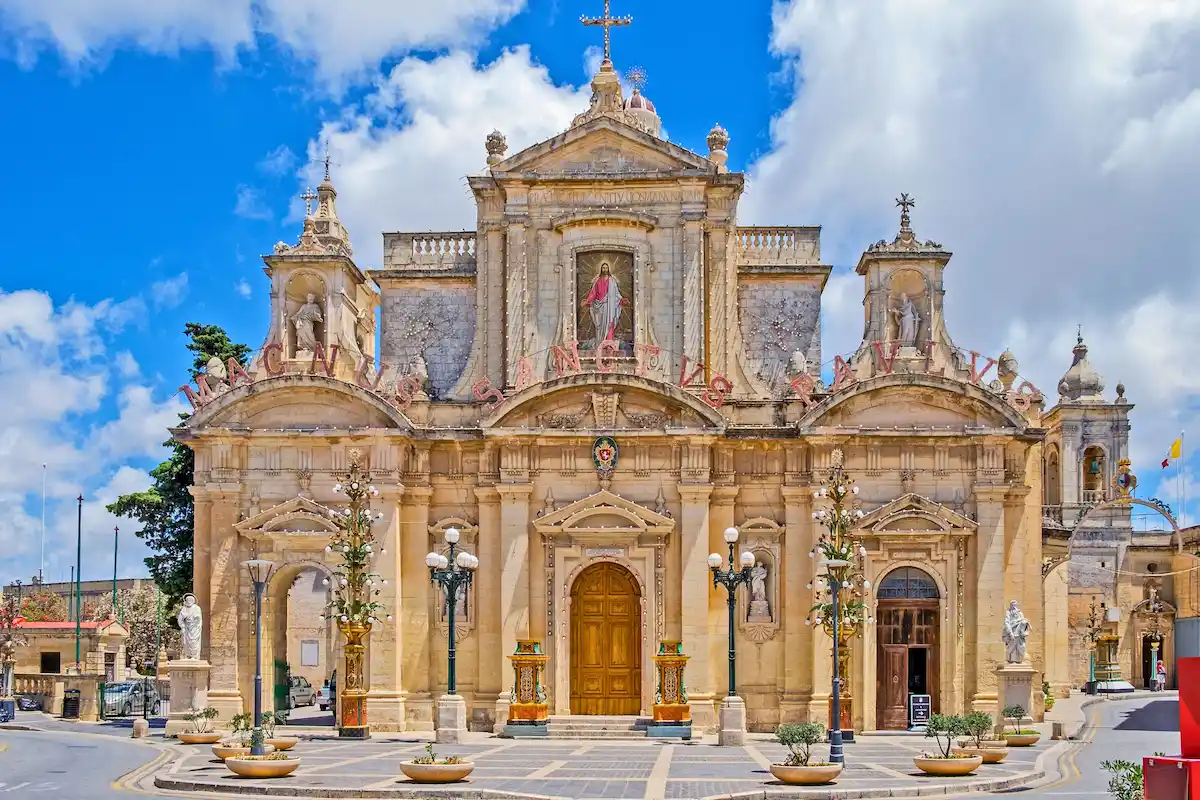
Rabat in Malta: The Town Next to Mdina
Rabat lies directly next to Mdina, and for most visitors it makes sense to visit both towns together as part of a single trip. From Valletta, you can get here by direct bus routes (most commonly 51, 52, or 53), with a journey time of around 40 minutes. You usually get off either at the stops near the entrance to Mdina or directly in Rabat. Both options work well.
If you arrive by car, parking is available at the car park between Rabat and Mdina, where the main bus terminus is also located, as well as in smaller parking areas around the edge of the historic centre, or beneath Mdina’s walls in the Saqqajja area near Greeks Gate.
For a first visit, it makes sense to start directly in the centre of Rabat, at the square by the Collegiate Church of St Paul. This is where the main sights, cafés, and entrances to the underground sites are concentrated. Even if you are short on time, it is recommended at a minimum to:
- walk through the central square with St Paul’s Church,
- visit the Catacombs of St Paul or St Agatha,
- and take a short walk through the surrounding streets, where Rabat feels most alive.
The whole of Rabat can be explored in half a day, but if you want to combine sightseeing with a relaxed lunch, coffee, and a slower pace, it is easy to spend a full day here.
If you want to explore Rabat and Mdina with historical context and include the catacombs, choosing a walking tour with a local guide is a practical option. These tours usually combine Mdina, Rabat, and underground sites into a single route and last approximately 2–3 hours.
While Mdina attracts visitors with its enclosed medieval monumentality, neighbouring Rabat has a very different character. It is more open, more lived-in, and above all more historically layered. It is not merely a suburban extension of Mdina, but an independent town with its own identity and deep roots that reach far beyond the Middle Ages. For visitors who are not satisfied with a quick walk and a few photographs, Rabat is quite literally a gold mine of stories, structures, and unexpected historical connections.
The History of Rabat, Malta: From Roman Melite to the Middle Ages
The name Rabat itself comes from Arabic and means “suburb” or “outskirts”. This was precisely the role the town played during the period of Arab rule over Malta (870–1091), when Mdina functioned as a fortified administrative centre and Rabat spread beyond its walls. However, the historical significance of this area is much older. Already in the Roman period, Rabat formed part of the wider urban complex of Melite, the island’s main centre at the time.
This continuity explains why traces of so many eras meet here today. In Rabat, a short walk can take you from Roman residential architecture to early Christian burial grounds, then on to Baroque monasteries from the time of the Knights of Malta and institutional remnants of the British colonial period. The historical layers do not sit side by side, but quite literally on top of one another – the underground catacombs form both the physical and symbolic foundation upon which churches, monasteries, and residential buildings were later built.
The Catacombs of Rabat: The Underground World of Early Christians
The most striking evidence of Rabat’s early Christian history lies underground. The Catacombs of St Paul and St Agatha form the largest complex of underground burial chambers in Malta and one of the island’s most important archaeological sites. They were created mainly in the 3rd and 4th centuries, at a time when Roman law prohibited burials within inhabited cities, and they testify to the presence of a substantial and organised Christian community in the area of Melite.
The catacombs are not simply cavities carved into limestone. Their layout is deliberate and, in places, surprisingly complex. You will find stone benches known as agape tables, which were likely used for commemorative meals connected with the cult of the dead, symbols of doves and fish, children’s graves, and family burial chambers. Rabat’s underground spaces therefore feel not only like places of death, but like an essential part of the spiritual and communal life of early Christians.
Symbolism in Rabat’s Catacombs: The Dove and the Fish
Simple symbols appear repeatedly in Rabat’s catacombs, most notably the dove and the fish. These are not decoration in the modern sense, nor random ornaments. In the early Christian context, they carried clear meaning and served as quiet but easily understood messages for members of the community.
The dove symbolised the soul of the deceased at peace. In a funerary context, it expressed the hope that death was not an end, but a transition. It also referred to the Holy Spirit and to the biblical image of the dove in the story of Noah, bringing news of the end of destruction and a new beginning. In the catacombs, the dove therefore did not mean “here is a grave”, but rather “here, life continues in another form”.
The fish is one of the oldest symbols of Christianity. It derives from the Greek word ichthys, used as an acronym for a confession of faith in Jesus Christ. At a time when Christians were not yet an officially recognised or secure community, the fish functioned as a discreet sign of recognition – intelligible to believers but not provocative to others. It also referred to baptism and rebirth, since fish live in water, and to Christ as provider, known from biblical stories of fish and bread.
Importantly, in early catacombs these symbols appear more frequently than the cross. At that time, the cross was still primarily an instrument of execution, and its positive symbolism developed only later. The image of a dove or a fish, by contrast, was simple, universal, and easily understood even by people who could not read or who spoke a different language.
The symbols in Rabat’s catacombs are therefore not decoration, but a visual language. They demonstrate that these underground spaces were used not only for burial, but also to preserve identity, faith, and cohesion within an early Christian community that existed on the margins of official society.
Above the Catacombs in Rabat: Churches, Monasteries, and Roman Houses
Directly above one of the most significant underground complexes stands the Collegiate Church of St Paul. According to early Christian tradition, it was built over the cave where the Apostle Paul is said to have stayed after his shipwreck on Malta. Whether one interprets this tradition symbolically or literally, the church played a central role in shaping Rabat’s religious identity.
Nearby is a Franciscan monastery with valuable collections of sacred art and a historic library. At the other end of the spectrum stands the Domus Romana, a Roman villa with preserved mosaics and artefacts of everyday life among the upper classes of ancient society. The contrast between an opulent Roman residence and the modest early Christian burial grounds beneath the town gives Rabat its distinctive depth.
Rabat as a Living Town: Everyday Life Beyond Tourist Routes
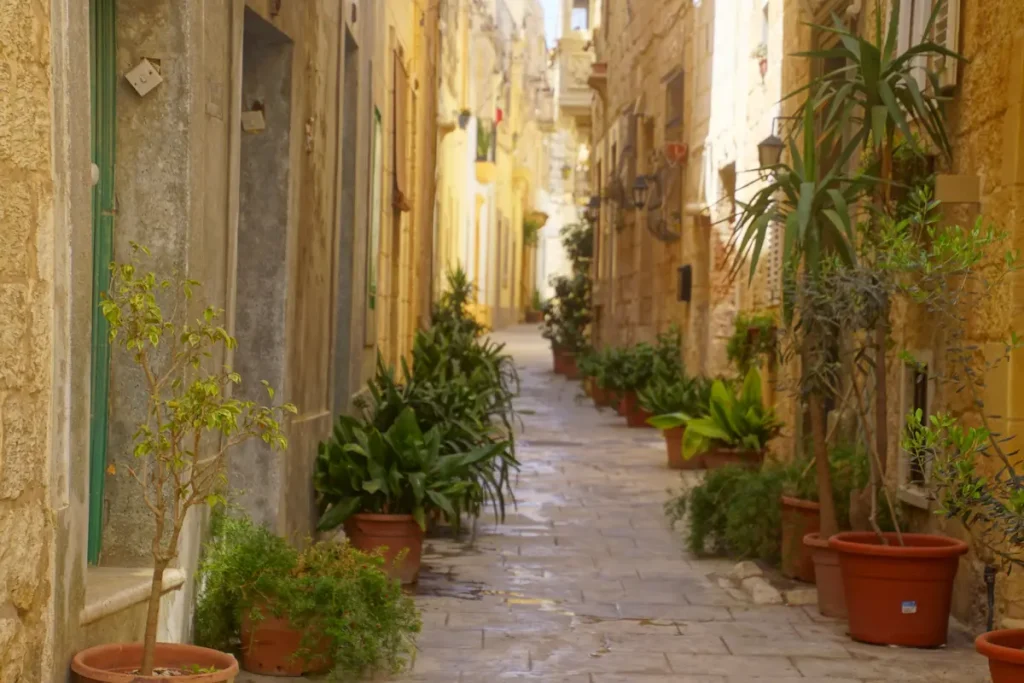
Unlike Mdina, Rabat has remained a genuinely inhabited town. Its narrow streets are not merely a backdrop, but spaces of everyday life. Locals sit outside their homes, bakeries sell fresh ftira, cafés serve qassatat, and the rhythm of the day follows local life rather than tour groups.
It is in the details that Rabat stands out most. Colourful Maltese doors, wrought-iron balconies, niches with statues of saints, and discreet churches such as Santa Marija ta’ Gesù or San Roque create a quiet, contemplative layer of the town that lies outside the main tourist routes.
Rabat is not a town of postcards or quick stops, but a town that must be read in layers. It is a town of depth – literally and symbolically. Beneath its streets lie centuries-old tombs, above them stand churches and monasteries, and in between unfolds ordinary daily life. If you want to experience Malta beyond bus windows and Mdina’s viewpoints, Rabat offers one of the most authentic keys to understanding the island’s history.
Related articles:
- Rabat underground: a town living above graves
- Melite and Roman houses in Malta: what survived and why…
- Mdina ≠ Rabat: museum and life side by side
- Why Rabat escapes tourists’ attention
- Why the streets of Rabat are so narrow
- Where to stay in Rabat and around Mdina
Is Rabat worth visiting if I have already seen Mdina?
Yes. Rabat offers a very different perspective on Maltese history and everyday life, with layers that go far beyond Mdina’s enclosed medieval core. Even a short walk reveals contrasts you won’t experience inside the city walls.
What makes Rabat historically different from Mdina?
While Mdina was a fortified administrative centre, Rabat developed as a lived-in town with roots stretching back to Roman Melite and early Christianity. Its history is not concentrated in one monument, but spread across underground spaces and ordinary streets.
Are Rabat’s catacombs only for history enthusiasts?
The catacombs are accessible to general visitors, but they are quiet, understated spaces focused on context rather than spectacle. They tend to appeal most to those interested in history, symbolism, and early Christian culture.
Is Rabat mainly a tourist town?
No. Rabat remains a working town shaped by daily life, not just visitor flows. Its streets, cafés, and small churches reflect local rhythms rather than curated tourist routes.