
Why the Order of St John Accepted Caravaggio in Malta – and Why It Rejected Him
How could an aristocratic order obsessed with lineage, discipline, and Christian morality accept among its members a man known for violence, impulsive behaviour, and murder? How could such a man be elevated to knighthood – and then, shortly afterwards, expelled without mercy?
The story of Caravaggio is not merely the dramatic fate of a single artist. It is, above all, a particularly telling example of how power, authority, and morality functioned within the Order of St John in the early modern period.
This text is not a defence of Caravaggio’s behaviour. Nor is it a romantic portrait of a “cursed genius”. It is an attempt to understand why the Order of St John was able to accept him – and why, in the end, it had to reject him.
Caravaggio as a Problem, Not a Hero
At the beginning of the 17th century, Caravaggio was among the most sought-after painters in Rome. At the same time, he was notorious for his violent temper, conflicts, and acts of aggression. In 1606, during a brawl, he killed a man named Ranuccio Tomassoni, a member of an influential Roman family connected to the city’s aristocracy and local power structures.
Flight from Rome: Why Malta Offered Protection
Malta therefore represented a logical choice for Caravaggio. After being sentenced in absentia in Rome, he could not remain in the Papal States and needed an institution with its own jurisdiction – one that, although politically intertwined with Spain and the Papal States, was not obliged to extradite him. Malta offered exactly that: a military order with international authority, capable of providing protection and a platform for negotiation.
Grand Master Wignacourt and His Interest in Caravaggio
At the time of Caravaggio’s stay in Malta, the Order of St John was led by Grand Master Alof de Wignacourt. He was not a passive guardian of tradition, but an ambitious leader with a clear vision, determined not only to cultivate his own image, but to transform Malta into a respected centre of power, taken seriously both politically and culturally.
Valletta was meant to project the image of an order that was not a provincial military force, but part of the European elite. And for that, fortifications and ships were not enough. High-level representation was required – architecture, ritual, and art capable not merely of displaying authority, but of enforcing it convincingly.
In this context, Caravaggio’s naturalistic art and his ability to depict death became tools of visual power. This is precisely why Caravaggio could be more attractive to the Order than disciplined, technically reliable painters who routinely worked on cathedral decoration and produced conventional religious imagery.
Why Caravaggio – and Not Another Painter
A number of artists worked on the decoration of St. John’s Co-Cathedral. Most were technically skilled, obedient, and easily replaceable, as they followed the widely accepted conventions of Baroque art. If you are interested in why the whole cathedral feels so opulent, and how Baroque art helped the Order build its authority, I explore this in more detail in the article Why St. John’s Co-Cathedral Is So Richly Decorated.
The Order did not need another “correct” Baroque composition. It needed an image of death that would shake the viewer to the core and make it uncomfortable to confront the truth: that death is not beautiful. An image that does not soothe, but forces the viewer to accept violence, sacrifice, and finality as part of the world’s order.
Caravaggio’s style – harsh light, raw flesh, blood without embellishment – corresponded precisely to the world of an order accustomed to war, injury, and death. The image was not meant to please. It was meant to strip away illusions.
Admission to the Order: An Alliance, Not Forgiveness
Caravaggio’s admission to the Order of St John in 1608 was exceptional, conditional, and unequal when compared to other members of the Order – but not in the sense that the Order abandoned its values. Caravaggio was not admitted as an aristocratic Knight of Justice, but as a Knight of Grace (Cavaliere di Grazia), a rank lower in the Order’s hierarchy.
A simple question may occur to the reader: how could an order founded on Christian faith accept a man who had killed someone? After all, the commandment “Thou shalt not kill” lies at the very core of biblical morality.
The Order did not accept Caravaggio as a moral example, nor did it excuse his past. Instead, it temporarily set aside the moral problem because his exceptional artistic talent was useful. In return, Caravaggio gained protection, status, and the hope of papal pardon.
St John the Baptist as the Order’s Patron – and the Meaning of Beheading
The choice of John the Baptist was not accidental. He was not a serene saint of altarpieces, but a prophetic figure standing at the very threshold of history. He emerged at the beginning of the 1st century AD, at a moment when the tradition of Old Testament prophets was closing and the new Christian era had not yet begun. In Christian tradition, he is understood as the last prophet of the Old Testament – the one who announces the coming of the Messiah, yet does not belong to the new age himself. This is precisely why he was inconvenient. He spoke openly, criticised the powerful, rejected compromise, and did not retreat even when his life was at stake.
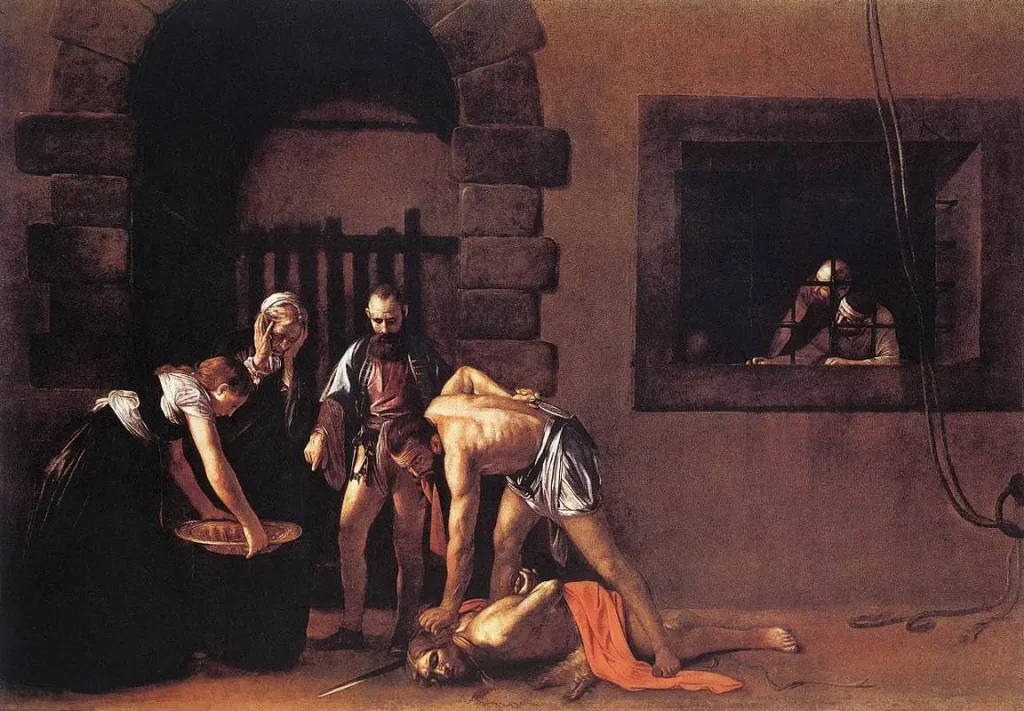
Why Caravaggio Signed This Particular Work
Caravaggio’s The Beheading of Saint John the Baptist is the only work he ever signed. And he did not sign it discreetly in a corner. His name is written in the blood flowing from the freshly severed neck of John.
If you are planning to visit the cathedral itself and want practical information about tickets, how long the visit takes, the audio guide, or evening programmes in the Oratory with Caravaggio’s painting, you can find those details in my separate guide to visiting St. John’s Co-Cathedral in Valletta.
Escape from Prison as a Political Solution
Unfortunately, due to his volatile nature, Caravaggio soon became involved in a conflict with other knights, during which injuries were sustained.
At first glance, this might appear to have been just another brawl. Violence was not uncommon among knights, and personal conflicts occurred even within the Order itself. The difference lay in who was fighting, under what circumstances, and how widely the incident became known. Unfortunately, the precise details of the altercation are unknown, but Caravaggio was imprisoned.
Once Caravaggio came into conflict with other knights, the matter was no longer a personal dispute between two men. It affected the Order itself – its discipline, hierarchy, and ability to maintain internal order. A rift within the Order undermined its authority both internally and externally.
Such a failure could not be overlooked. Not because violence was unimaginable, but because it demonstrated that Caravaggio was incapable of functioning within the system that provided him with protection. At that point, even exceptional talent became a liability. Caravaggio was imprisoned at Fort St Angelo, from which he nevertheless managed to escape.
It is therefore legitimate to ask whether Caravaggio’s escape was at least tacitly tolerated. At that moment, the Order of St John found itself in a situation where no solution was good. Keeping Caravaggio imprisoned meant a long-term problem and the risk of scandal. Handing him over to Rome would have been an indirect admission that the Order had accepted a fugitive and failed to control him. An escape – followed by expulsion – allowed the entire affair to be closed without further disturbance.
Why Caravaggio Chose Escape – and What Followed
From Caravaggio’s perspective, escape was not an irrational gesture. It was a pragmatic choice. As an outlaw sentenced to death in the Papal States, he had to fear that he could be handed over to Rome from prison at any time – or simply eliminated without trial.
Expulsion from the Order meant the loss of protection and prestige. Remaining in prison could mean death. And if you know that extradition to Rome means death, or death there meant the same outcome, you naturally choose escape – even at the cost of living as a fugitive.
After fleeing Malta, Caravaggio never again found the stable protection of an institution. He moved between Sicily and Naples, living in constant fear and physical as well as psychological exhaustion. He continued to paint, but his life narrowed to survival and the hope of pardon. He died in 1610 at the age of 38, under unclear circumstances.
What This Story Reveals About Power
The Order of St John did not accept Caravaggio despite who he was. It accepted him because of how he could be useful. And it rejected him the moment he ceased to respect the boundaries of power.
Talent is tolerated as long as it serves. Morality is flexible as long as it does not threaten authority. Once the balance is broken, exclusion follows – without sentiment.
Caravaggio’s fate is therefore not merely a personal tragedy. It is an exact image of the world in which he lived – a world where faith, violence, and power did not form a contradiction, but a single functional whole.
Opening image: an illustrative portrait inspired by Caravaggio.