How to Bring a Dog, Cat or Other Pets to Malta: Rules and Requirements
Malta is an island state with strict veterinary regulations. Bringing a dog, cat, guinea pig, or even a parrot is not complicated, but it does require thorough preparation before arrival and a good understanding of both EU legislation and Maltese national rules. For birds and small mammals, the conditions may additionally vary depending on the specific species and current veterinary measures. This guide explains everything you need to comply with, including direct links to official forms and practical, experience-based tips.
Pet Import Rules for Malta: EU and National Regulations Explained
The European Union has established a unified framework for the non-commercial movement of dogs, cats and ferrets between Member States (Regulation (EU) No 576/2013). The core requirements are clear identification of the animal, a valid rabies vaccination, and an appropriate travel document.
EU rules provide a common baseline, but individual Member States may impose additional national requirements. As an island state, Malta takes a particularly cautious approach to the importation of animals, as the introduction of disease is far more difficult to manage here than on the mainland. This means that documents which are fully sufficient in another EU country may not automatically meet Maltese requirements.
Overview of EU rules for travellers with pets: EUROPA – Travelling with pets.
Maltese official guidelines for travelling with animals: Travel with your Pet to Malta (PDF).
Bringing Pets to Malta from the EU and Non-EU Countries
Travelling with Pets from the EU
The following documents are required:
- ISO 11784/11785 compliant microchip (implanted before rabies vaccination).
- Rabies vaccination (for the primary vaccination, at least 21 days must have passed).
- EU Pet Passport issued by an authorised veterinarian.
- Dog: mandatory treatment against the tapeworm Echinococcus multilocularis 24–120 hours before entry. This is a single deworming treatment administered by a veterinarian – correct timing is the key factor. The treatment must be recorded by the vet in the passport or certificate. Malta is considered free from endemic occurrence of this parasite and therefore enforces this requirement very strictly.
- Advance notification of arrival: Pets Arrival Notification.
Authorities do not focus only on whether documents are formally valid, but also on whether each step was carried out in the correct order and within the prescribed time limits. The most common issues arise with rabies vaccination and the tapeworm treatment for dogs.
Bringing Pets from Non-EU and Unlisted Countries
- All of the above requirements (microchip, rabies vaccination, and for dogs mandatory tapeworm treatment), plus an EU Animal Health Certificate (which replaces the EU Pet Passport), issued by an official veterinarian (valid for 10 days from issuance for entry into the EU).
- For so-called “unlisted countries”, a Rabies Antibody Titration Test is required (blood sample taken no earlier than 30 days after rabies vaccination; entry into the EU no earlier than 3 months after sampling).
- For certain animal species (especially birds and other exotic species), an import permit from AHWD may be required. For common small mammals such as guinea pigs, this permit is usually not required.
When travelling from third countries, significantly longer and more careful preparation is required. In some cases, the entire process from the first vaccination to permitted entry into the EU can take several months. If you are planning relocation or a long-term stay in Malta, it is advisable to start dealing with veterinary requirements well in advance and to make sure your veterinarian has experience issuing international certificates.
The EU distinguishes only between so-called listed and unlisted non-EU countries. If a country does not appear on the official EU list of approved states, it is automatically considered an unlisted country. Animals arriving from these countries are subject to stricter veterinary conditions, including a mandatory rabies antibody test and a three-month waiting period before entry into the EU. The list of countries and specific requirements for travel from each country can be found here.
For animals coming from unlisted countries, a rabies antibody test is required. In practice, this works relatively simply: the animal must first be vaccinated against rabies, no earlier than 30 days after vaccination a blood sample is taken for the antibody test, and from the date of sampling a mandatory three-month waiting period applies before travelling to the EU. This is not a quarantine after arrival. If all conditions are met, the animal undergoes a document check upon arrival in the EU or Malta and is then released to its owner.
Rules for Different Types of Pets: Dogs, Cats, Guinea Pigs and Birds
Requirements for travelling with animals to Malta vary significantly depending on the species. While for some animals the focus is mainly on vaccination and documentation, others may be subject to individual assessment by the authorities.
Dogs, Cats and Ferrets
Dogs, cats and ferrets fall under a clearly defined EU regime. The key elements are the microchip, rabies vaccination, a correctly maintained passport or certificate, and for dogs the mandatory tapeworm treatment. If all time limits and documents are complied with, entry into Malta proceeds under the standard procedure without additional permits.
Guinea Pigs and Other Small Mammals
For common small mammals such as guinea pigs, the regime is usually simpler. Rabies-related requirements do not apply, and a specific AHWD import permit is generally not required. However, basic veterinary checks or confirmations may still apply depending on the country of origin and current measures, so it is always advisable to verify the conditions before travelling.
Parrots and Birds: Special Import Requirements
For birds, the situation is the least uniform. Requirements may vary depending on species, origin and the current epidemiological situation. In practice, prior approval or an import permit from AHWD may be required, along with additional specific documents. For birds, it is therefore advisable to plan well in advance and to expect individual case assessment.
Microchip Requirements for Pets
Every animal must be uniquely identifiable. The standard is an ISO 11784/11785 compliant microchip, which must be implanted before rabies vaccination.
The microchip serves as the primary identification element used by authorities to verify that the animal matches the travel documents. A common mistake is implanting the microchip after rabies vaccination – in such cases, the vaccination is considered invalid and must be repeated. This can result in delays of several weeks or even make it impossible to travel on the planned date.
Rabies Vaccination Rules and Validity
The animal must be old enough to meet the rabies vaccination requirements when travelling to Malta. Rabies vaccination can be administered from 12 weeks of age at the earliest, and the vaccine becomes valid only after a further 21 days have passed. This means it is not possible to travel to Malta with a puppy or kitten younger than approximately 15 weeks. For travel from third countries, the minimum age may be extended further due to additional mandatory waiting periods.
Without a valid rabies vaccination, the animal will not be allowed to enter Malta. Booster vaccinations must follow without interruption and be properly recorded in the passport or certificate.
From the authorities’ perspective, rabies is a key disease, and its vaccination is therefore checked very strictly. What matters is not only the validity of the vaccine itself, but also the correct timing between individual doses. If the vaccination schedule is interrupted, a new vaccination and a renewed waiting period may be required.
Mandatory Tapeworm Treatment
Under its national veterinary regulations, Malta requires all dogs to be treated against the tapeworm Echinococcus multilocularis within 24–120 hours before entry. The treatment must be administered by a veterinarian and recorded in the passport or certificate. Malta is considered free from endemic occurrence of this parasite and therefore enforces this requirement with particular strictness.
Tapeworm treatment is not treated as a mere formality in Malta. Authorities check not only whether the correct substance was used, but also the precise timing of its administration. If the treatment falls outside the prescribed window, it may be deemed invalid even if it is otherwise correctly recorded in the documents.
Practical Tips for Flying to Malta with Pets
- If you need an antibody test, start preparations as much as four months in advance.
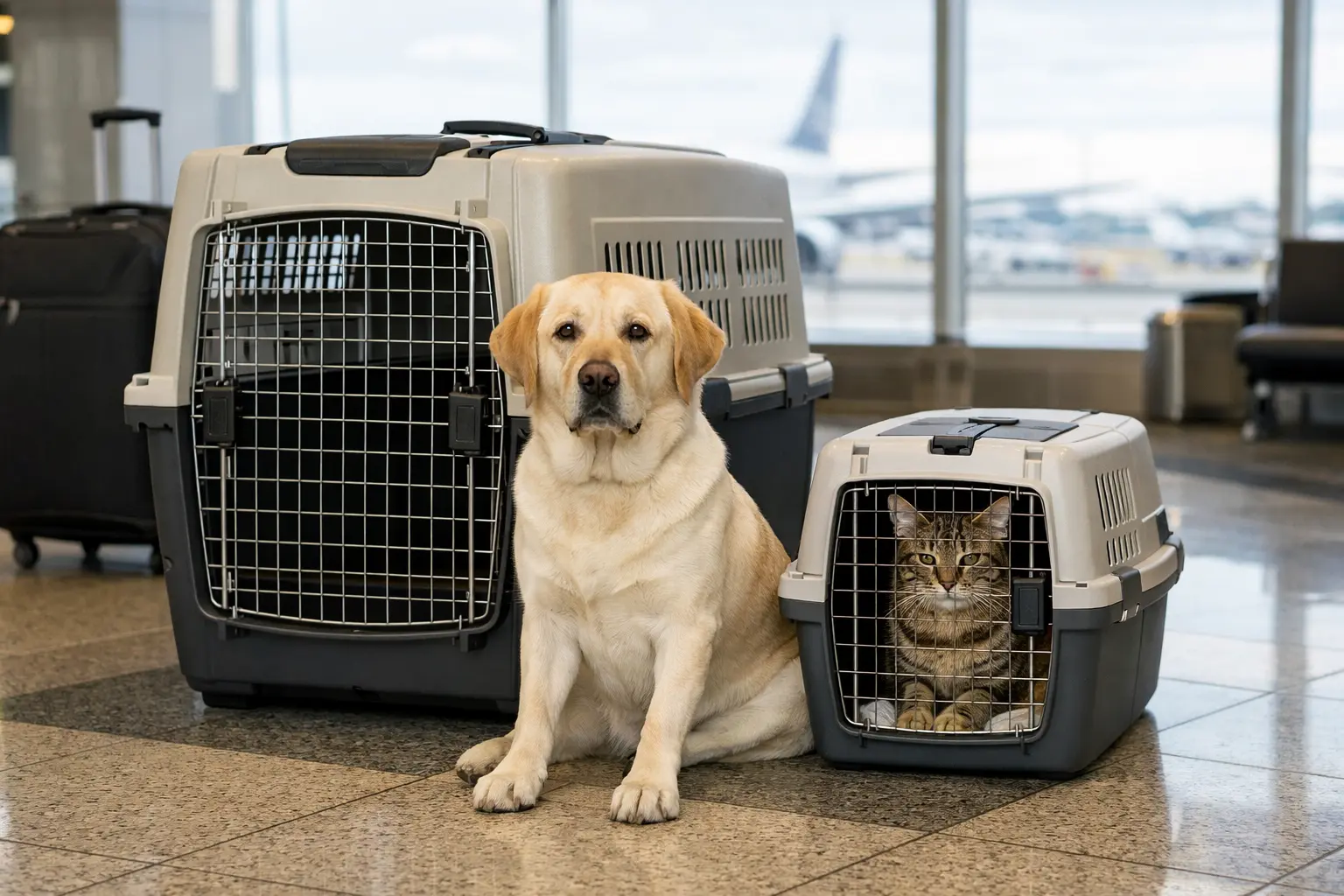
- Choose an IATA-approved transport crate and accustom the animal to it gradually.
- Place an absorbent pad in the crate and provide a drinking container or a bowl with an ice cube.
- Attach a label with the animal’s name, your contact details and flight number to the crate.
- When booking flights, focus on standard airlines – low-cost carriers generally do not allow animal transport.
- During summer months, opt for evening or night flights where possible to reduce exposure to high temperatures during airport handling.
- Before purchasing a ticket, contact the airline to confirm that animal transport is permitted on the specific flight and that capacity has not already been reached.
- Whenever possible, choose a direct flight – this reduces stress for the animal and the risk of complications during transfers.
- If travelling with a transfer, check the conditions at transit airports and the airline’s temperature limits. During hot periods, animal transport in the cargo hold may be restricted or suspended altogether, even if all documents are in order.
- Keep veterinary documents not only in physical form but also electronically for quick access during checks.
- For in-cabin transport, always factor in the combined weight of the animal and the carrier – weight limits are strictly enforced.
- Always consult a veterinarian before administering sedatives – some medications are not recommended for air travel because they increase the risk of adverse effects during pressure changes. Some airlines explicitly prohibit sedatives in their terms and conditions.
- After arrival, allow the animal time to rest, hydrate and acclimatise, especially when travelling during summer.
- If you plan to return or continue travelling with your animal, check the requirements for the return journey as well – conditions may differ depending on the destination country.
An air transport crate must comply with IATA standards and be large enough for the animal to stand, turn around and lie down comfortably. For larger animals transported in the hold (cargo), rigid plastic crates with metal doors are used, such as the Ferplast Atlas or Gulliver Transport Box ranges, available from various European and international retailers. The exact size and type of crate must always be aligned with the requirements of the specific airline and the size of your animal.
Practical preparation plays a crucial role when travelling with animals. Even if all formal requirements are met, poor logistics or stress can significantly complicate the journey for the animal. The better the animal is prepared for travel and accustomed to the transport crate, the calmer the flight itself and the subsequent checks on arrival tend to be.
Frequently Asked Questions About Bringing Pets to Malta
Do pets need quarantine when arriving in Malta?
No routine quarantine is required for pets entering Malta if all veterinary conditions are met in advance. The decision is based on document checks rather than post-arrival isolation. Quarantine may only be considered in exceptional cases where requirements are not fulfilled or documents are missing.
Can I bring a puppy or kitten to Malta?
Yes, but only if the animal is old enough to meet the mandatory vaccination and identification requirements. Very young puppies and kittens usually do not qualify due to minimum age limits linked to rabies vaccination and related waiting periods.
Is bringing pets to Malta more complicated than to other EU countries?
In practice, yes. While Malta follows EU pet travel rules, it applies additional national controls due to its island status. This means that steps which may be routine elsewhere in the EU are often checked more strictly when entering Malta.