Silkworms in Malta: What to Feed Them (And Where to Find Mulberry Leaves)
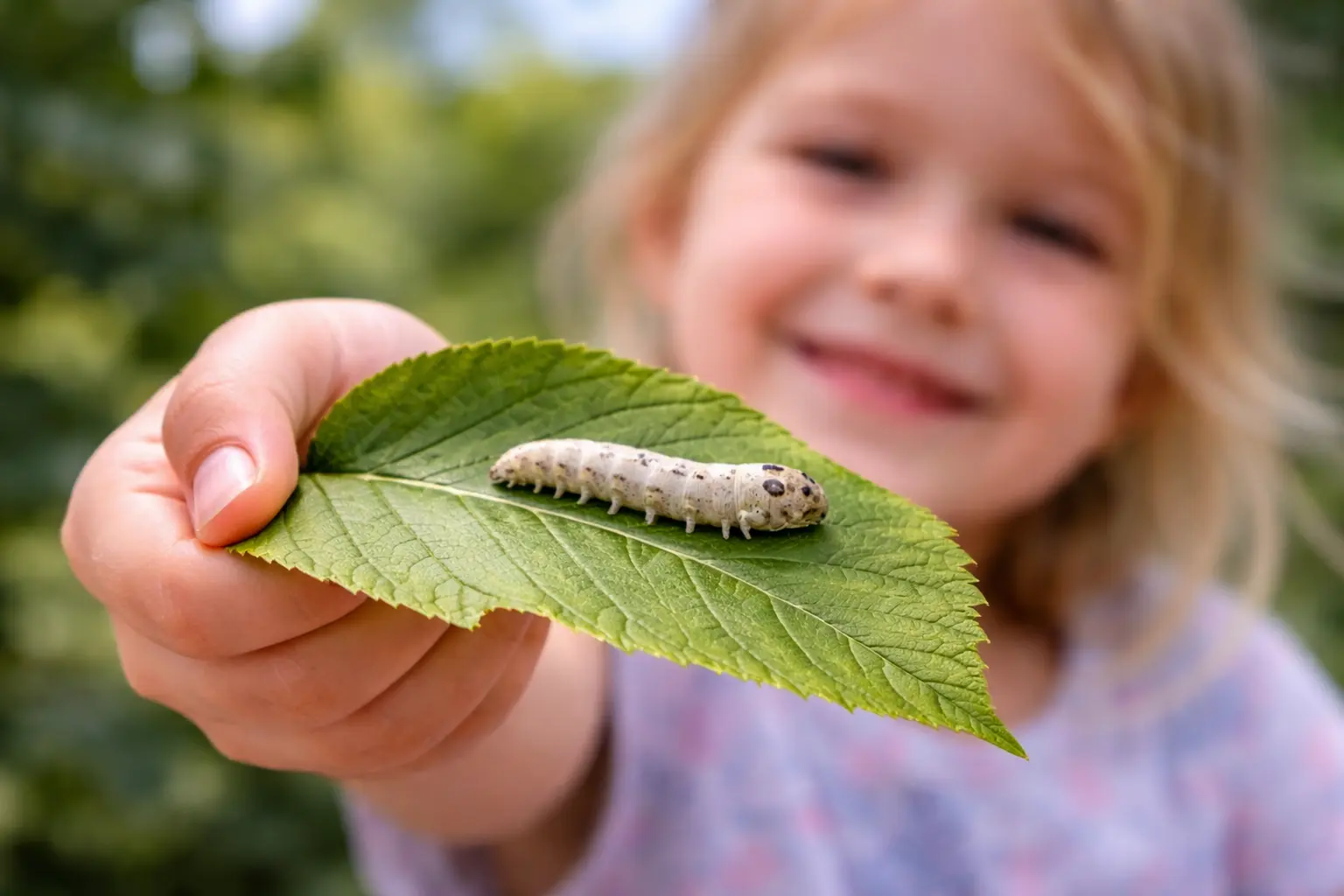
The other day, my child came home from school proudly carrying a “great science project” in a small box and announcing full responsibility for seeing it through to the end. Inside, at the bottom of the box, were several pale grey caterpillars with brown heads, sitting on leaves. The task sounds simple: feed them, watch them spin cocoons, and wait for them to transform into moths. The caterpillars were given out by the teacher, everything seems simple at first… until you discover one crucial detail. Silkworms eat only fresh mulberry leaves—nothing else will keep them alive.
And that’s the moment a small detective game begins. Where do you actually find those leaves in Malta?
What Do Silkworms Eat? (And Why Nothing Else Works)
Silkworms are surprisingly picky. There is no “backup option.” Lettuce, herbs, or anything that might seem similar simply will not work, even though other caterpillars might eat it. Without fresh mulberry leaves, they will not survive. This means that a regular supermarket or garden centre won’t help— you actually need to go outside and find a tree yourself.
Do Mulberry Trees Grow in Malta? Where to Find Them
The good news is that mulberry trees do grow in Malta. They’re simply not as visible as palms or citrus trees, so most people don’t notice them. You’ll typically find them in less manicured parts of the island—around older houses, in rural areas, or in gardens with a longer history. They also appear in towns like Żabbar, Żejtun, or Bormla, and quite often along wider streets with tree-lined central strips between two lanes of traffic.
However, they are not systematically planted—it’s more a case of individual trees scattered across the landscape.
How to Identify a Mulberry Tree
The leaves are not always identical—even on a single tree, they can vary. Some are smooth, others lobed; sometimes they resemble maple leaves, other times they are completely simple in shape. What they have in common is that they are soft, thin, and light to medium green in colour. If the tree bears fruit, identification becomes much easier—the fruits look like small blackberries that gradually darken as they ripen.
Once picked, the leaves wilt quickly, so it’s best to store them in the fridge in a plastic bag to retain moisture and slow down the wilting process.
Silkworm Life Cycle: What Happens Next
At first glance, the silkworm may seem like an unremarkable caterpillar, but in reality, it is one of the most fascinating organisms a child can encounter in a school project. Over the course of its short life, it undergoes a transformation that is far more dramatic than it might appear.
One of the most striking features is the speed of its growth. Within just a few weeks, a caterpillar can increase its body weight up to ten thousand times. This is why it often feels like it is “constantly eating.” In reality, it is storing energy needed to build its cocoon and transform into an adult.
The cocoon itself is a small miracle. It is not made from multiple fibres, as one might assume, but from a single continuous silk thread that can reach up to around one kilometre in length. The caterpillar releases it gradually, wrapping it around itself until a firm protective shell is formed.
It is also interesting that the silkworm is now entirely dependent on humans. Unlike most insects, it would hardly survive in the wild. It has been bred for thousands of years specifically for silk production, and in the process, it has lost many abilities it would otherwise need in nature.
At the end of the cycle, another paradox appears. The adult moth that emerges from the cocoon is unable to truly fly and cannot feed at all. It has no functional mouthparts, so it does not eat. Its sole purpose is reproduction, and within a few days, its life comes to an end.
The entire process feels almost unbelievable—from a small caterpillar fully dependent on mulberry leaves emerges a moth that can no longer take care of itself.
What This Project Revealed Beyond the Silkworms
But this project turned out to be about more than just feeding caterpillars. What surprised me most was that, out of a class of twenty-three children, my son was the only one who chose to take a few silkworms home. The others decided not to continue with the project beyond the classroom.
It made me think back to my own childhood. Back then, projects like this were not optional — each of us was given silkworms and expected to care for them until they formed cocoons. At first, we all reacted in much the same way: a lot of hesitation, a fair amount of “no way”, and a genuine sense of discomfort. But gradually, something changed. As we fed them, cleaned after them, and checked on them every day, that initial feeling of disgust slowly turned into curiosity, and later into a quiet sense of responsibility. By the time they finally transformed, we felt genuinely proud that we had seen the whole process through.
Watching my son now — checking on them every day, cleaning their space, and bringing them fresh leaves — brings back that same quiet pride for me. It may seem like a small thing, but experiences like this naturally teach care, patience, and the understanding that living things depend on us.
I noticed a similar shift during an ordinary moment at the beach. When some spilled juice attracted a few bees, the first reaction around us was panic. I stayed calm and simply watched them as they landed on me, crawled over my skin, and drank the spilled juice. My daughter, who is usually afraid of them, gradually calmed down and began watching them too. It was a quiet moment that reminded me how deeply children mirror our reactions — and how easily fear can turn into curiosity when given the space to do so.
It is precisely when participation becomes optional that I sometimes wonder whether children miss out on this kind of transformation — not only the insect’s, but also their own.
Some of the things we would never choose at first can still become the very ones we are proudest of in the end.
Why Silk Production Never Took Off in Malta
At first glance, it may seem unusual. Mulberry trees grow relatively well in Malta, coping with dry conditions and local climate much like olive trees. So why didn’t they become a common agricultural crop, and why did silk production never truly develop?
The answer lies not in the tree itself, but in what you want to produce from it. With olives, the situation is straightforward—a tree grows slowly, requires minimal care, and produces a harvest once a year. Even in dry conditions, this makes long-term sense. Mulberry trees could function similarly if the focus were only on the tree.
However, silk production works very differently. It is not about fruit, but about leaves—and in large quantities. Silkworms are extremely voracious and require vast amounts of fresh leaves over a short period of time. If you want to produce silk on a larger scale, a few trees are not enough—you need entire plantations and a stable food supply for thousands of caterpillars.
To give an idea: producing a single silk T-shirt requires roughly 5,000 silkworm cocoons, although the exact number varies depending on fabric thickness and garment design. Those same caterpillars will consume around 100 kg of leaves during their development, which could easily come from five mature mulberry trees.
And this is where Malta reaches its limits. The island has limited land, no rivers, and historically very restricted irrigation options. What works on a small scale—a few trees near a house—breaks down when you try to expand it. The demands for space, water, and labour increase rapidly.
During the rule of the Knights of St John, silk may have seemed like an excellent idea. It was a high-value luxury commodity with low volume, ideal for trade. Attempts to produce it were therefore not accidental, but a logical economic experiment of the time.
Over time, however, it became clear that local conditions were not suitable for such production. Larger and more fertile regions in Europe—such as Italy and France—were able to produce silk more efficiently and at lower cost. As a result, silk production in Malta never expanded significantly and gradually disappeared.
The mulberry trees, however, remained. Today, they serve as a quiet reminder that even on a small island, ambitious ideas once existed—ideas that made sense on paper but ultimately collided with environmental limits.