The Malta School System Explained: From Kindergarten to University
If you are moving to Malta with children, sooner or later you will come across the question of how the local education system actually works. At first glance, the Maltese system may seem similar to the Czech one. Children attend childcare or kindergarten, then move on to primary school and later continue to secondary or higher education.
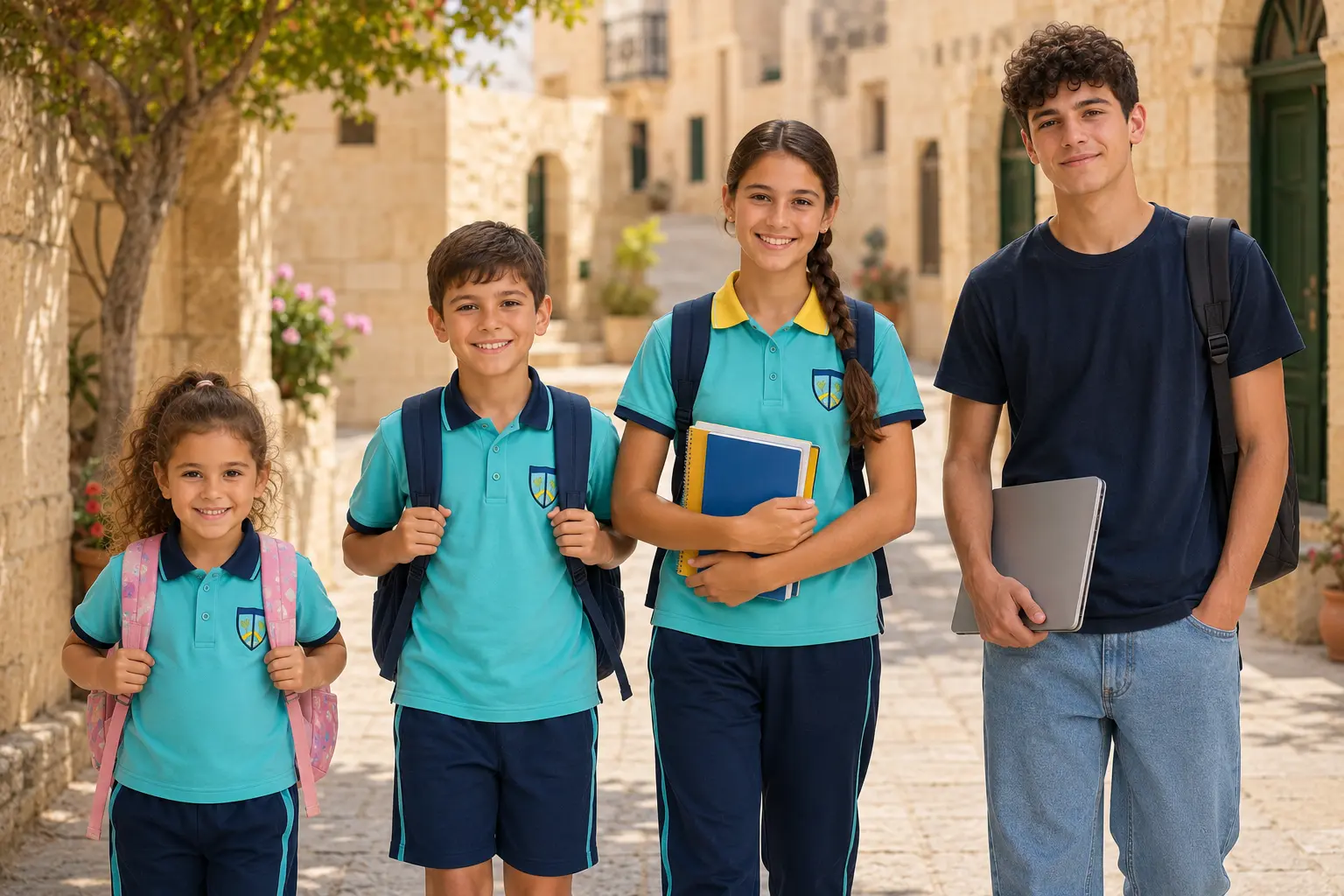
In reality, however, there are several important differences. Malta uses bilingual education in Maltese and English, state schools are organised into so-called colleges, children wear uniforms, and during their school years they gradually encounter educational pathways based on their academic interests and strengths.
How Schools in Malta Work
| Child’s Age | Education Stage |
|---|---|
| 0–3 years | Childcare |
| 3–5 years | Kindergarten |
| 6–11 years | Primary School (Grade 1–6) |
| 11–13 years | Middle School (Grade 7–8) |
| 13–16 years | Secondary School (Grade 9–11) |
| 16–18 years | Sixth Form, MCAST or ITS |
| 18+ | University of Malta or other tertiary education |
State, Church and Private Schools: What’s the Difference?
The Maltese education system is not made up solely of state schools. Parents can choose between three main types of schools: state schools, church schools and private schools. All three options guide students from early childhood education through to their final examinations, but they differ in funding, admissions procedures and day-to-day operations.
State schools are attended by the majority of children in Malta. They are funded by the government and students are generally assigned according to their place of residence. Church schools operate under Catholic institutions and are highly sought after by many Maltese families. Admission is usually based on a lottery system or sibling priority. Their funding comes from a combination of government support, church contributions and voluntary donations from parents. Private schools set their own tuition fees, admission criteria and educational programmes, with some offering international curricula.
Regardless of the type of school chosen, students progress through the same main educational stages – from kindergarten through primary and secondary school to further education after completing compulsory schooling.
How the College Network System Works
State schools in Malta are not organised as independent institutions. Instead, they are grouped into regional networks known as College Networks. Each college oversees several kindergarten, primary, middle and secondary schools within a specific area of the island.
Students typically remain within the same college network for most of their school journey. This means that after completing primary school, they usually continue to a middle school and later a secondary school belonging to the same network. As a result, schools within one college often share the same uniform colours, organise joint events and follow connected educational pathways.
Within the state system, assignment to a specific college is based on the child’s place of residence, which plays an important role when enrolling a child in a state school.
- Maria Regina College
- St Clare College
- St Ignatius College
- St Thomas More College
- St Benedict College
- St Nicholas College
- St Margaret College
- Gozo College
Each of these colleges manages several school campuses and provides education from the earliest years through to secondary school within its region.
Once a family has chosen between a state, church or private school, the next step is the enrolment process. In the state system, the key factors are the family’s place of residence and the relevant College Network responsible for schools in that area. As part of the application process, parents are required to provide proof of the child’s identity, proof of address and any additional documents requested by the education authorities.
Childcare (0–3 Years)
Childcare centres in Malta accept children from as young as three months old. Through the Free Childcare Scheme, many families can access childcare services free of charge. Private childcare centres are also available and offer a variety of programmes and educational approaches.
Kindergarten (Ages 3–5)
After childcare comes kindergarten. Most children start at the age of three and gradually prepare for the transition to primary school. Teachers commonly use both Maltese and English, allowing children to develop familiarity with both languages naturally. School uniforms are also a normal part of kindergarten life.
Primary School (Grade 1–6)
Primary school consists of six year groups, known as Grade 1 through Grade 6. Children usually begin at the age of six and remain in primary education until around eleven years old.
During the early years, pupils spend most of their time with a class teacher who teaches the majority of core subjects. However, the class teacher typically changes each school year. Specialist teachers are introduced for subjects such as Physical Education, Music and several other areas of the curriculum.
Teaching takes place in a bilingual environment. English is used particularly in Mathematics and Science subjects, while Maltese is commonly used in subjects focused on language, culture and national history. It is also very common for teachers to explain something in Maltese and then repeat it in English.
School life includes uniforms, school events, sports days, cultural activities, educational outings and continuous assessment throughout the year.
Many Maltese schools also hold regular school assemblies. During these gatherings, school leaders share important information, announce upcoming events and recognise student achievements. Assemblies may also include the singing of the Maltese national anthem, whose lyrics take the form of a prayer. If you are interested in its origins, author and meaning, you can learn more in our article about Dun Karm Psaila.
Malta has a long Christian tradition that is still reflected in many aspects of school life today. Based on the experiences of my own children attending state primary and secondary schools, some teachers include a short prayer before snack time or before lessons begin. The exact approach varies from one teacher to another – some classes pray regularly, while others do not pray at all.
In Grade 1, parents choose whether their child will attend Religion lessons or the alternative Ethics subject. This choice does not affect a child’s participation in everyday school life, and schools often organise shared cultural and religious activities for all students. If parents are uncomfortable with their child’s participation in a religious service, they can request an exemption, and the child will usually be assigned to another class for the duration of the event.
From personal experience, I can share an example from Grade 2, when my daughter’s classmates celebrated their First Holy Communion. Although my daughter attended Ethics classes, the school asked in advance whether she would like to take part in the event. She agreed. On the day of the ceremony, she dressed formally, attended school as usual and travelled with her classmates by school bus to the church where the ceremony took place. She was not part of the sacrament itself but was welcome to observe as a guest. Another guest attending alongside her was her best friend from a Muslim family. However, approaches may vary between schools.
The school year in Malta is divided into three terms. At the end of each term, parents receive reports and updates about their child’s academic progress. Alongside day-to-day classroom performance, school tests and end-of-year examinations also play an important role.
Malta uses a percentage-based assessment system based on a combination of Continuous Assessment and Annual Exams, which together contribute to the student’s final Global Mark.
Beyond grades themselves, it is also helpful to understand how teachers discuss student performance and how to interpret feedback throughout the school year. This is particularly important for parents unfamiliar with the communication style commonly used in English-speaking schools, which can sometimes be more diplomatic and less direct. If you come from a culture where problems are discussed openly and explicitly, some comments may appear ambiguous or even create the impression that everything is fine when concerns actually exist.
At the end of Grade 6, students sit the National Benchmark Exams. These assessments evaluate academic achievement and are used to place students into different academic streams when they move on to middle school.
Although most students continue through the standard pathway within their College Network, the Maltese education system also offers several specialised educational routes. Some children transfer to sports or arts schools, while others join specialist sports or music programmes within mainstream secondary schools. Entry requirements, selection procedures and levels of specialisation vary between programmes.
Middle School (Grade 7–8)
After completing primary school, students move on to middle school within their College Network. Middle school covers Grade 7 and Grade 8 and serves as a transition between primary education and the more specialised studies that follow.
Students may also have the opportunity to attend a Sports School or an Arts School, while some College Networks offer specialised sports and music programmes within mainstream schools.
Middle school is often the first time students encounter a larger number of teachers, as individual subjects are taught by specialists. Learning becomes more independent and gradually prepares students for future academic choices. Schools provide textbooks free of charge, and these must be returned at the end of the school year. If a book is lost or damaged, parents are usually required to cover the replacement cost. Based on my children’s experience, textbooks are often available in both English and Maltese, allowing students to choose the language version they prefer.
During Grade 8, students begin selecting subjects that interest them and that they may continue studying in secondary school before eventually taking SEC examinations in those subjects.
Secondary School (Grade 9–11)
Secondary school covers Grade 9 through Grade 11 and represents the final stage of compulsory education in Malta.
Students continue studying core subjects while also focusing more heavily on the areas they selected during Grade 8. Their studies gradually prepare them for the SEC examinations. Students who successfully complete their SEC exams receive a school leaving certificate confirming the completion of compulsory education.
For most students, SEC examinations are a major academic milestone. They are not simply final exams taken at the end of secondary school, but part of a broader system that includes School-Based Assessments (SBA), different examination levels, registration as a school or private candidate, and the pathways available afterwards, including Sixth Form, MCAST and ITS.
Maltese schools and educational institutions are gradually moving towards digital certificates. Students may encounter them during compulsory schooling and later when receiving SEC results, the Matriculation Certificate or university qualifications. These documents are issued through the Blockcerts system, allowing long-term storage and electronic verification.
What Happens After Secondary School?
After completing Grade 11, students finish compulsory education and choose their next educational pathway. Malta offers several options depending on academic performance, personal interests and future career goals.
The most common routes are Junior College or church-run Sixth Form schools, which prepare students for A Levels and university education. Students may also continue at vocational institutions such as MCAST or the Institute of Tourism Studies (ITS). Each institution focuses on different types of qualifications and career pathways.
Sixth Form (Ages 16–18)
After completing secondary school and successfully passing SEC examinations, many students continue to Sixth Form. This two-year stage prepares students for higher education and concludes with Advanced Level and Intermediate Level examinations.
Sixth Form is not a single school but a type of post-secondary study offered by several institutions across Malta. The best-known is Junior College, which forms part of the University of Malta. Students may also continue at institutions such as Giovanni Curmi Higher Secondary School or at certain church schools that operate their own Sixth Form programmes.
The results achieved during Sixth Form play an important role in determining eligibility for university admission and other forms of tertiary education.
MCAST
MCAST (Malta College of Arts, Science and Technology) is the largest vocational education institution in Malta. Students can study technical subjects, business, healthcare, information technology, construction, creative disciplines and many other career-focused programmes.
MCAST offers vocational certificates, diplomas and higher education qualifications. Many programmes combine classroom learning with practical training designed to prepare students for employment.
Institute of Tourism Studies (ITS)
The Institute of Tourism Studies (ITS) specialises in education related to tourism, hospitality, catering and associated service industries. ITS prepares students for careers in hotels, restaurants, tourism businesses and other sectors connected to Malta’s tourism industry.
Programmes combine professional training with practical industry experience and collaboration with businesses operating in the tourism sector.
University of Malta
The University of Malta is the country’s main public university. It offers bachelor’s, master’s and doctoral programmes across a wide range of disciplines, from medicine and law to engineering, humanities, science and social sciences.
Alongside the University of Malta, the islands are also home to several other higher education institutions and international study programmes.
School Transport, After-School Programmes and Student Support
School life in Malta does not end when the final lesson finishes. Many families make use of additional programmes and services that support children before school, after school and during school holidays.
These include services such as school transport, Breakfast Club, School Klabb, SkolaSajf and a variety of other programmes organised by schools and government entities. Some operate during the school year, while others are voluntary programmes available outside regular school hours. Additional support may include Reading Recovery, speech and language support, or free Catch-Up Classes focused on Mathematics, English, Maltese and other key subjects.
Alongside official school programmes, there are also various informal traditions connected to school life. During the years my children have attended Maltese schools, I have repeatedly seen parents organise group gifts for teachers or Learning Support Educators (LSEs) at the end of each term. This is not a school requirement but rather a parent-led gesture of appreciation. Contributions and gift arrangements vary considerably between classes. Participation is entirely voluntary, and parents can decide for themselves whether they wish to take part.
Summary
The Maltese education system guides children from childcare through kindergarten, primary school, middle school and secondary school before continuing to Sixth Form, MCAST, ITS or university education. Whether a child attends a state, church or private school, the different educational stages build upon one another, providing a pathway from early childhood education through to higher education and professional qualifications.
You may also find these articles useful: