Is Għar Dalam Worth Visiting — Or Just Another Stop You Can Skip?
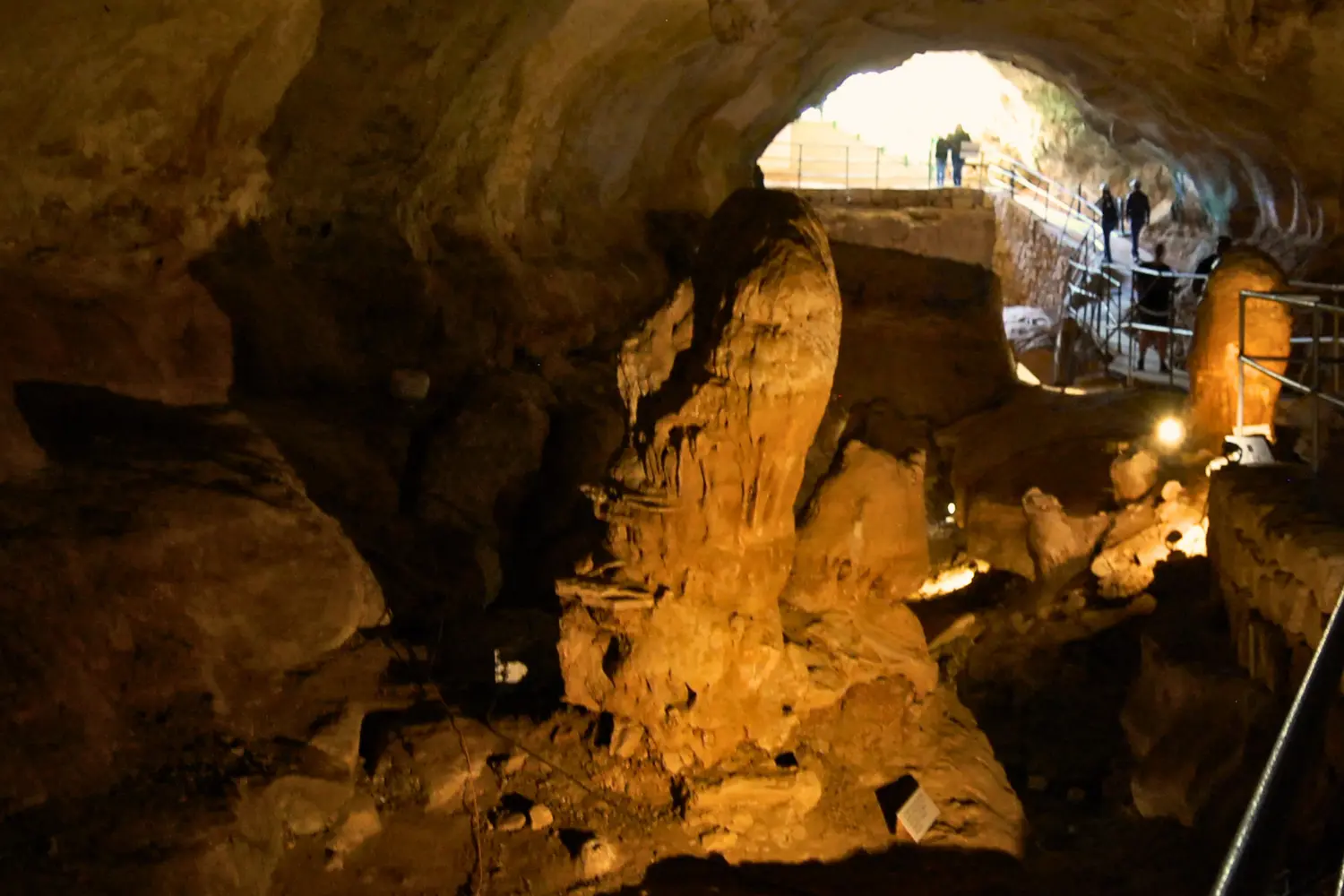
Għar Dalam is an unassuming cave in the south of the island near Birżebbuġa. At first glance, it does not feel particularly special – and that is exactly why many people underestimate it, because it lacks a strong visual “wow effect”. Its strength is not in what you see, but in what it helps you understand. The fossil findings reveal that Malta once had a completely different ecosystem and landscape than it does today. Malta once had elephants and hippopotamuses—and this is one of the few places where you can understand why.
Għar Dalam (pronounced “ardalam”) means “dark cave,” which accurately reflects its character. However, do not expect dramatic views or a vast cave filled with stalactites. The accessible section is relatively short and visually quite simple. The real experience happens in understanding the context.
This is where you begin to realise that present-day Malta is only the final stage of a much longer development that goes deep into the Pleistocene period (a time of repeated cold and warmer cycles), roughly between 2.6 million and 11,000 years ago.
If you are wondering whether you will find dinosaur fossils here, the answer is simple: no. Dinosaurs went extinct around 66 million years ago, while Malta itself began forming much later, approximately 20 million years ago. These two timelines never overlapped.
Who Should Visit Għar Dalam (And Who Can Skip It)
Who should visit Għar Dalam:
- if you are interested in how Malta formed and what it looked like in prehistory
- if you want to understand context, not just “see a place”
- if you are travelling with children who enjoy animals and fossils
- if you are spending a week on the island and exploring the south – then it works well as a short stop combined with Blue Grotto or Ħaġar Qim
Who might find the visit disappointing:
- if you are looking for a visually striking experience
- if you expect a large cave or a strong “wow effect”
- if you only have 3–4 days on the island
In other words: if you enjoy context, prehistory, and evolution, Għar Dalam is worth a short stop. If you are focusing only on visually impressive places, you can skip it.
The next section will show why this understated site is so important from a scientific and historical perspective.
What Malta Was Like During the Ice Age (And Why It Looked Different)
Malta was part of the Ice Age (Pleistocene), but it was never covered by glaciers. The reason is simple: the island lies too far south and does not have enough elevation for glaciers to form, unlike mountain ranges such as the Alps or the Pyrenees. You will not find any traces of glaciation or snowy landscapes like those associated with northern Europe.
Instead, Malta had a cooler and wetter climate than today. There was more rainfall, and water gradually shaped the landscape. This is how valleys formed – features that are still typical of Malta today, such as Wied Dalam, Wied il-Għasel, or Wied il-Luq. Today these valleys appear dry and unremarkable, but they are the result of long-term erosion caused by flowing water.
During the Ice Age, vast amounts of water were locked in glaciers covering large parts of the northern hemisphere. The largest ice sheets were located in present-day Canada and the northern United States, as well as in Scandinavia – Norway, Sweden, and Finland. In some areas, the ice was several kilometres thick and completely covered landscapes that today consist of forests, cities, or lakes.
The ice did not only affect mountain peaks but covered entire regions, in some cases extending deep into central Europe. Smaller glaciers also existed in mountain ranges such as the Alps or the Pyrenees, but the volume of water they contained was much smaller compared to these massive ice sheets.
These vast “permanent ice” regions held so much water that global sea levels dropped – in some places by more than 100 metres. To imagine this, think of a thirty-storey building disappearing below sea level, while coastlines shifted significantly further away from their current positions.
Today, Malta lies about 90 kilometres from Sicily. During the Ice Age, this distance was much smaller, and shallow areas or partially exposed land could appear between the islands. Animals did not swim to Malta – they reached it gradually through an environment that no longer exists today.
This means Malta was not an isolated island as we know it today. Instead, it was part of a wider landscape that allowed animals to spread. From the area of present-day Sicily, animals searching for new food sources gradually reached Malta in several waves over different periods.
A natural question is whether it was possible to continue further south toward North Africa, such as Tunisia or Libya. In this case, geography played a different role. The seabed between Malta and Africa is much deeper and more complex, and even with lower sea levels, no continuous land bridge formed. This route remained closed.
What Animals Lived in Malta Before Humans
Fossils found in Għar Dalam show that elephants, deer, and hippopotamuses once lived in Malta. In addition, there were also giant tortoises – not small animals you can hold in your hand, but creatures that could exceed one metre in length and weigh tens to hundreds of kilograms, similar to modern Galápagos tortoises.
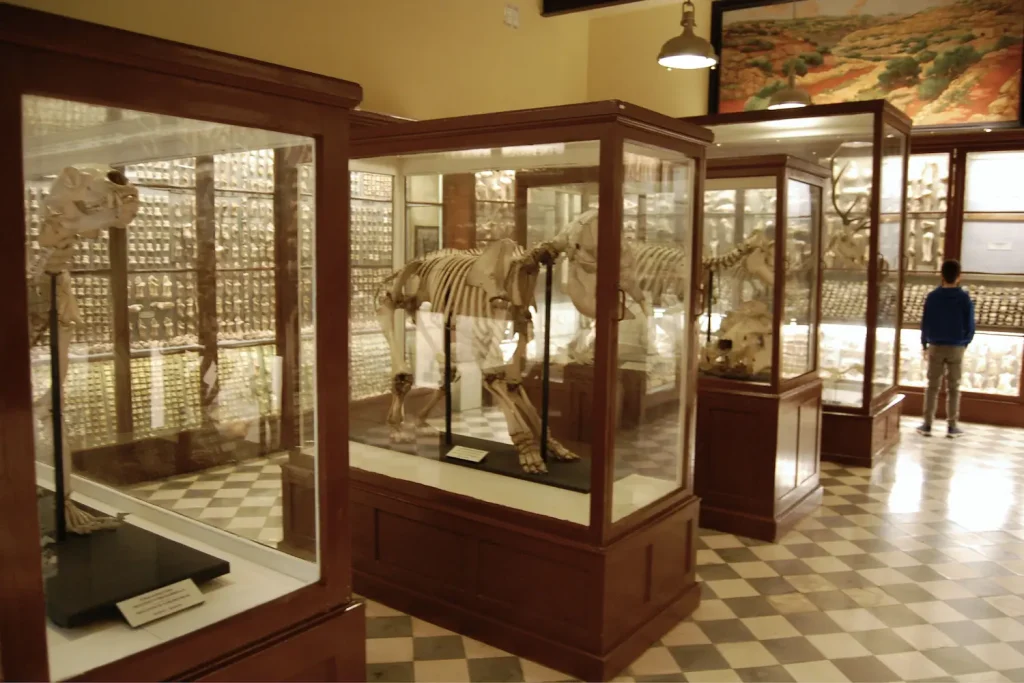
One of the biggest surprises is often the presence of hippopotamuses. Today, we associate them almost exclusively with Africa, but during the Ice Age they also lived in Europe. A European species of hippopotamus existed in areas such as Spain and France and eventually reached Malta.
These European hippopotamuses were not direct ancestors of modern ones. They were closely related species that spread into Europe from Africa and later became extinct, mainly due to climate and environmental changes.
When people think of the Ice Age, they often imagine snow and permanently frozen landscapes. In the Mediterranean, however, conditions were different. The climate was cooler than today but also wetter, with more water in the environment. This combination allowed rivers, lakes, and wetlands to form – ideal habitats for animals such as hippopotamuses.
Alongside them lived predators such as bears and wolves. Malta at that time was far from a quiet island – it was a much wilder and biologically richer environment than it is today.
Most of these animals went extinct before humans arrived. The main causes were climate change and the gradual isolation of the island, which significantly altered survival conditions.
Why Elephants in Malta Became Small (Island Evolution Explained)
As glaciers melted at the end of the Ice Age, sea levels rose again. Malta became separated from the surrounding land, and animals that had reached the island earlier became isolated.
This is where one of the most fascinating evolutionary processes begins. An island is not a “smaller version of a continent” – it is an environment with completely different rules.
In Malta, we do not see just fewer European animals, but a completely restructured ecosystem. Large mammals gradually became smaller because they required less energy, while smaller species could grow larger due to the absence of natural predators.
A typical example is elephants. Originally large animals of the genus Palaeoloxodon, they reached several metres in height on the European mainland. In Malta, however, due to limited food resources, they gradually shrank to about one metre.
To imagine this: a Maltese elephant could be roughly the size of a large dog or a pony – something you could picture standing next to you, not a giant animal from the African savannah.
The same process affected other species, such as deer, which were significantly smaller in Malta than their mainland relatives.
At the same time, the opposite principle applies: some smaller species can grow larger on isolated islands. That is why Malta presents combinations such as dwarf elephants alongside giant tortoises.
This is a classic example of how strongly isolation can influence evolution – a phenomenon also linked to the so-called founder effect.
How Għar Dalam Cave Was Formed
The Għar Dalam cave did not form suddenly but very slowly. Rainwater seeped into limestone, a rock formed from ancient marine organisms.
As water passed through soil, it absorbed carbon dioxide (CO₂), forming a weak acid – carbonic acid. This gradually dissolved the limestone.
This was not a fast process but one that took thousands of years. Small cracks in the rock gradually widened and connected until the cave space formed.
Once the cave existed, the opposite process began. Water started bringing soil, sand, and other materials into it, depositing them in layers – and these layers now act as a timeline of Malta’s development.
How did the animals, whose fossils we find here today, get into the cave? Some may have fallen in and been unable to escape. Another possibility is that water carried bones into the cave along with sediments, as it lies within a valley where material could be washed in during heavy rains.
While their remains would have decomposed on the surface, they were preserved inside the cave – which is why it now acts as a concentrated “archive” of Malta’s ancient landscape.
Għar Dalam during World War II
During World War II, the cave was used as a storage site for aviation fuel, and according to information boards, there are also engravings and graffiti left by soldiers. I did not notice them myself, as they are not clearly marked or highlighted. What caught my attention instead was the loud chirping of small birds nesting in cracks near the cave entrance.
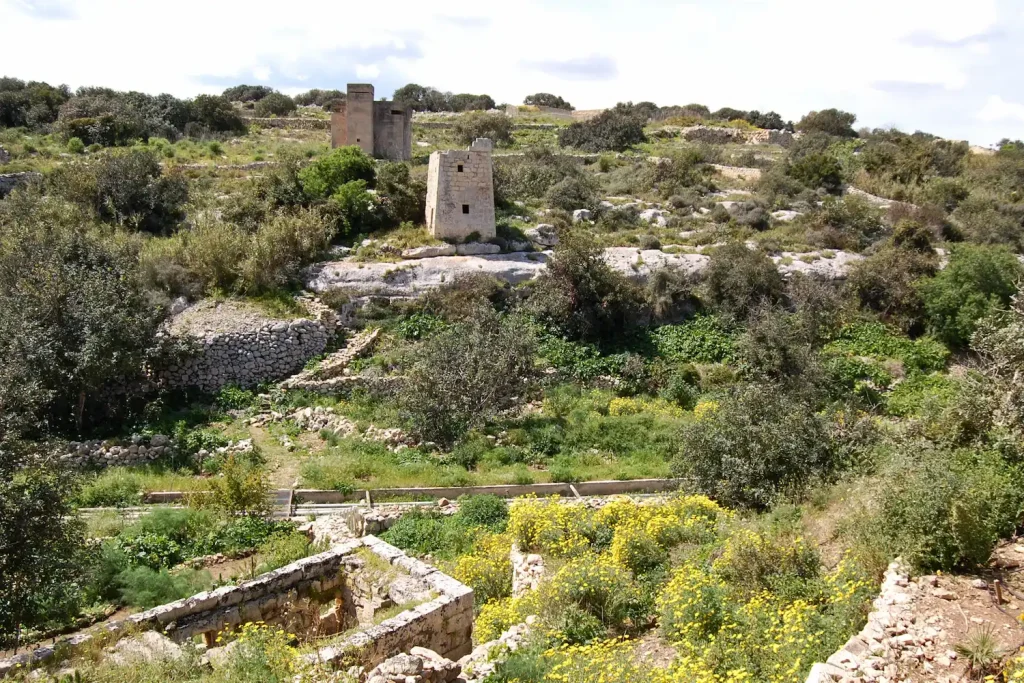
Opposite the cave, there is a low concrete bunker (a so-called pillbox), which formed part of the island’s defence during World War II. These structures were not placed randomly – they were often positioned on elevated ground with a clear view, allowing control of natural corridors in the landscape, such as valleys.
From the Wied Dalam area, you can see as far as the Malta Freeport cargo terminal in Birżebbuġa, which helps explain why this location had strategic importance in the past.
The site also includes a small educational area focused on native Maltese flora. Created in cooperation with BirdLife Malta, it shows what local natural environments can look like under dry Mediterranean conditions.
Għar Dalam Malta Visitor Guide: Tickets, Opening Hours and How to Get There
Għar Dalam is a relatively short stop. Most visitors need around 20 to 30 minutes to explore both the cave and the museum.
Do not expect a modern, interactive exhibition full of visual effects. The museum feels more like a classic 20th-century display, with glass cases, skeletal remains, and information panels. It is managed by Heritage Malta, and tickets can be purchased on site.
Despite this more traditional style, the exhibition is well presented and clearly explains the formation of the cave and the animals that once lived in Malta. It may feel outdated to some, but if you know what to look for, it provides excellent context for what you see inside the cave.
The site is located in the south of the island near Birżebbuġa. The easiest way to get here is by car (free parking is available) or by bus from Valletta.
If you plan to explore the south without dealing with transport logistics, organised tours are a good option – especially if you prefer not to drive or coordinate buses. They often combine Għar Dalam with places like Blue Grotto or Ħaġar Qim, allowing you to see multiple sites in one day.
An alternative is a hop-on hop-off bus, which is more suitable for a general overview of the southern part of the island. The downside is that it is more of a tourist transport service without a dedicated guide. Audio commentary is usually available, but it tends to be quite general. If you are interested in details, you will learn more directly on site, for example in the museum.
The museum is accessible with a stroller, but expect occasional steps, and note that the cave itself is not accessible with a stroller.
The best time to visit is from February to May, when the surroundings are green and in bloom. During the rest of the year, the landscape will appear dry and arid.
The most interesting part of this place is not what you see at first glance, but the context you take away with you.
- bones of dwarf elephants and hippopotamuses
- layers of history stretching back hundreds of thousands of years
- evidence of the island’s very ancient development
Is Għar Dalam Worth Visiting?
Għar Dalam is not a must-see for everyone. However, if you enjoy understanding context and do not want to see only photogenic places, it is one of the most interesting short stops on the island.
If you know why you are going, it becomes one of the most fascinating places in Malta. If you expect a strong visual experience, it may feel underwhelming.