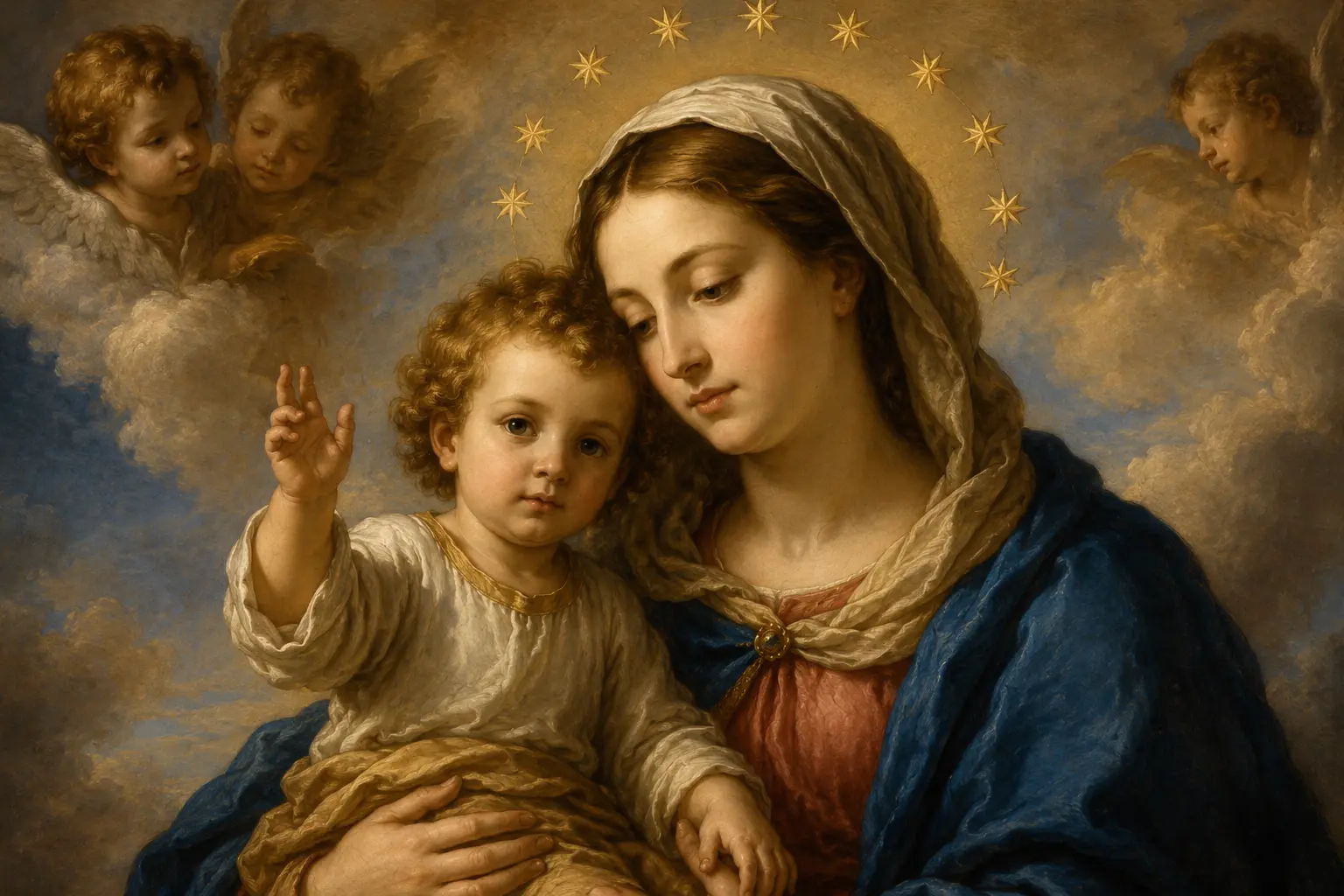
Assumption, Ascension and Immaculate Conception: What’s the Difference?
When I began writing about the feast of Santa Marija in Malta, I realised that I was just as confused by some Christian terms as many other people are. And that is hardly surprising. Words such as Assumption, Ascension and Immaculate Conception may sound as though they belong to the same story, but they describe entirely different events.
Most of the confusion centres on Mary and Jesus. Who, according to Christian belief, was conceived without original sin—and what does original sin actually mean? Who was conceived without a human father? Who was taken into heaven, and who ascended into heaven? In fact, these are four separate concepts.
The Assumption of Mary
The Catholic Church teaches that Mary, the mother of Jesus, was taken body and soul into heavenly glory at the end of her earthly life. This is the event commemorated on 15 August, the feast known in Malta as Santa Marija.
Interestingly, Catholic dogma does not define whether Mary died before the Assumption. When Pope Pius XII formally defined the Assumption as an article of Catholic faith in 1950, he stated that Mary was taken into heavenly glory “after the completion of her earthly life”. The definition itself therefore leaves the question of her death open.
The Ascension of Jesus
The Ascension is a different event and concerns Jesus. According to Christian belief, Jesus ascended into heaven after his resurrection. This is why Christians speak of the Ascension of Jesus but the Assumption of Mary: Jesus ascended, while Mary was assumed, or taken up, into heaven.
The Feast of the Ascension traditionally falls on the fortieth day after Easter, although in some countries its observance is transferred to the following Sunday. Unlike the Assumption of Mary, it therefore does not fall on the same calendar date every year.
The Immaculate Conception
This is probably the most common misunderstanding. The Immaculate Conception does not refer to the conception of Jesus. It refers to the conception of Mary herself.
The Catholic Church teaches that Mary was preserved from original sin from the first moment of her conception. It does not mean that she was conceived without sexual intercourse. According to Christian tradition, Mary had human parents like everyone else—Joachim and Anne. The doctrine concerns her spiritual state from the moment she was conceived, not the physical circumstances of her conception.
The feast date offers a useful way to remember this. The Immaculate Conception is celebrated on 8 December, exactly nine months before the Feast of the Nativity of Mary on 8 September.
The Virgin Birth of Jesus
The Virgin Birth, by contrast, concerns Jesus. It refers to the Christian belief that Mary conceived Jesus through the Holy Spirit, rather than through sexual intercourse with a man.
The Virgin Birth of Jesus is often confused with the Immaculate Conception of Mary. They are two different claims: one concerns how Jesus was conceived, while the other concerns Mary’s spiritual state from the first moment of her own conception.
Assumption, Ascension, Immaculate Conception and Virgin Birth compared
| Term | Who it concerns | What it means |
|---|---|---|
| Immaculate Conception | Mary | According to Catholic teaching, Mary was preserved from original sin from the moment of her conception. |
| Virgin Birth | Jesus | Mary conceived Jesus through the Holy Spirit, without a human father. |
| Ascension | Jesus | Jesus ascended into heaven after his resurrection. |
| Assumption | Mary | Mary was taken body and soul into heavenly glory at the end of her earthly life. |
What is original sin?
To understand the Immaculate Conception, one more term needs explaining: original sin.
According to Christian tradition, humanity inherited a damaged relationship with God after Adam and Eve. This does not mean that a newborn baby is personally guilty of wrongdoing. It describes a condition of human nature into which, according to Catholic teaching, every person is born. Baptism frees a person from original sin, although Catholic teaching holds that its consequences remain.
The Catholic Church believes that Mary was the exception: God preserved her from original sin from the first moment of her existence because he had chosen her to be the mother of Jesus. This is why she is described as having been immaculately conceived.
Why were babies once baptised so soon after birth?
Belief in original sin had very practical consequences in the past. Infant mortality was high, and parents feared not only for their child’s life but also for the child’s fate after death if they died without being baptised. It was therefore common for babies to be baptised very soon after birth.
If a newborn baby was in danger of dying, there was no need to wait for a priest. An emergency baptism could be performed by a layperson, and in the past midwives often assumed this responsibility because they were already present at the birth. A valid baptism did not require an elaborate ceremony: water was poured over the child and the person baptising said, “I baptise you in the name of the Father, and of the Son, and of the Holy Spirit.” If the child survived, the remaining parts of the baptismal rite were completed in church later.
How did Joseph respond to Mary’s pregnancy in the Bible?
According to the Gospel of Matthew, Joseph discovered that Mary was pregnant before they had begun living together as husband and wife. Marriage in the Jewish society of the time did not follow the simple sequence in which we tend to imagine it today—engagement, wedding and then marriage. It involved two successive stages.
The first was known as erusin, or kiddushin. After this stage, the man and woman were legally regarded as husband and wife, although the woman would normally remain in her family home and the couple had not yet begun married life together. The union could not simply be called off. Ending it required a divorce, and if the man died, the woman was considered a widow.
Only then came the second stage, nissuin, when the woman entered her husband’s home and their life together began.
It is during the period between the legally binding betrothal and the beginning of their married life together that the Gospel of Matthew places Mary’s pregnancy.
Matthew writes that Joseph did not want to expose Mary to public disgrace, so he decided to end their union quietly. This does not mean that her pregnancy could have remained secret. A private separation was instead a way to avoid a public accusation of adultery and the scandal that could have had serious consequences for Mary in the society of the time.
According to the Gospel, the situation changed after an angel appeared to Joseph in a dream and told him that the child had been conceived through the Holy Spirit. Joseph abandoned his original plan, took Mary into his home and began living with her as her husband. In doing so, he also publicly accepted her child into his family.
Old Testament law prescribed extremely severe penalties for sexual offences involving a betrothed woman, including death. However, this does not automatically mean that Mary genuinely faced being stoned in the period in which Matthew sets the story. The Gospel itself makes no such claim; it explicitly speaks of Joseph’s desire to spare Mary public disgrace.
Which of these does Malta celebrate as Santa Marija?
Santa Marija is the Feast of the Assumption of Mary. It does not celebrate Mary’s conception or the conception of Jesus, nor is it the Ascension of Christ. The Assumption falls on 15 August and has become one of Malta’s most important annual feasts over the centuries.
In Malta, 15 August also acquired an additional historical meaning. In August 1942, an Allied convoy sent as part of Operation Pedestal reached the besieged island. In Malta, it became known as the Santa Marija Convoy. Religious tradition thus became intertwined with the memory of one of the most dramatic events in modern Maltese history.
These terms belong to Christian belief and theology. This article explains what the Catholic Church teaches and what biblical texts state; it does not attempt to prove the described religious events as historical fact.
You may also find these articles useful: