Driving in Malta: A Practical Overview of Rules, Parking and Local Habits
Driving in Malta can be challenging at times, but it’s manageable. From lively traffic and driving on the left to rental-car pitfalls and parking rules, this guide summarises everything you need to know — and adds practical tips on petrol stations, taxis, and what to do if you’re involved in an accident.
Driving in Malta: Local driving style (horns, improvisation, lively traffic)
Don’t expect calm roads and strict, predictable rule-following. Indicators are used sparingly; often they’re replaced by a hand gesture out of the window — and you’re left guessing whether the driver is actually turning or just talking to a passenger while gesticulating. At junctions, the rule often feels like “whoever moves first, goes”, and be prepared: if you don’t pull away within a second of the light turning green, you’ll hear a horn. “Zipper merging” doesn’t really work — it’s usually about who dares to squeeze in first.
Add to that drivers with a phone in hand, those who ignore stop signs and simply keep going, or drivers who tailgate. And now and then you’ll see someone overtake from the slower lane and try to force their way in front of you. The best one is when two acquaintances meet on the road — both stop, roll down the window, and start chatting while a queue builds up behind them. It doesn’t take long for a chorus of horns to erupt. Sometimes honking is just a warning — “careful, I’m coming through” — other times it’s pure impatience: “why is this taking you so long?”.
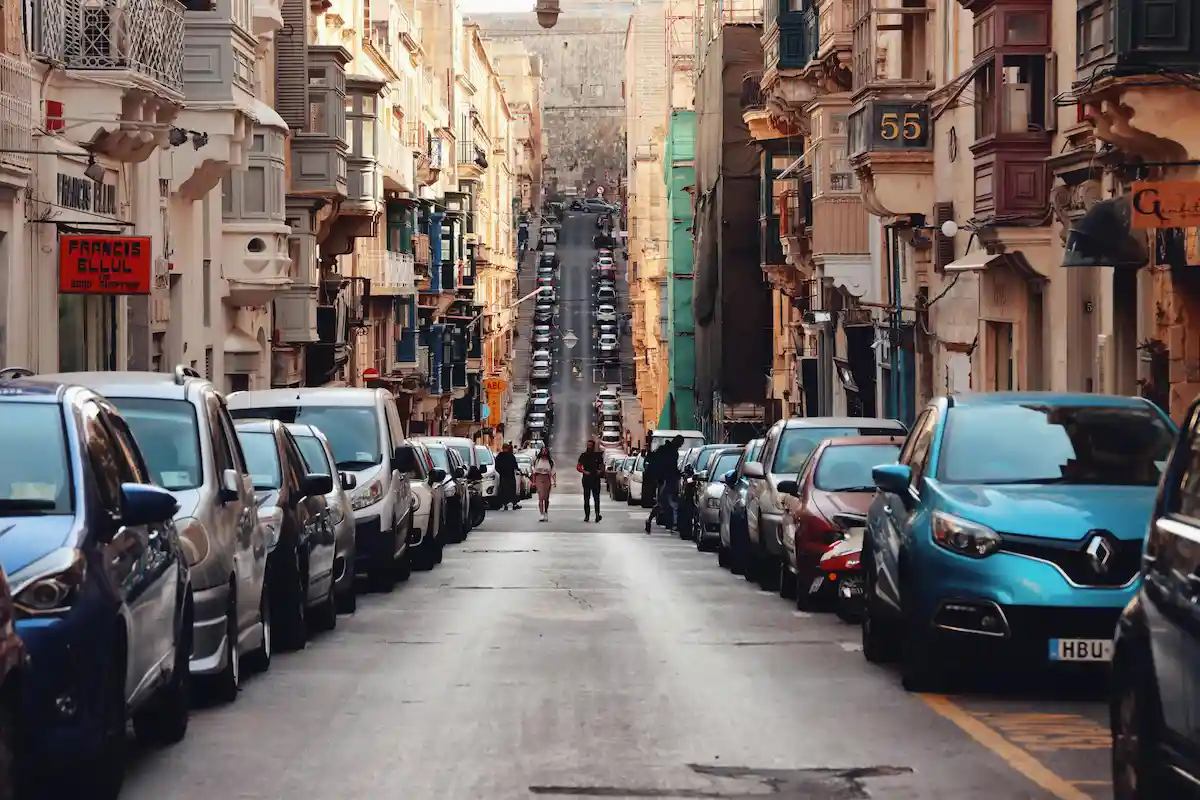
Overall, driving in Malta can feel like an adrenaline sport. Rule number one: stay alert at all times and try to anticipate what others will do. Minor bumps, scratches, and dents are everyday occurrences here, so when choosing a rental car, make sure you understand exactly what the insurance covers. Main roads are usually in decent condition, but side streets often suffer from potholes and uneven surfaces. In historic centres you’ll find narrow lanes — and you’ll quickly understand why most Maltese drive small cars like a Picanto, often with a wing mirror taped up after someone clipped it.
In Malta you drive on the left — a legacy of British rule. If you’ve never driven in left-hand traffic, the first few days can be quite challenging. On the other hand, the road layout is such that accidentally turning into oncoming traffic is essentially not possible.

Speed limits in Malta
The official limits in Malta are 50 km/h in built-up areas and 80 km/h outside them. In practice, speed is often dictated by traffic density, road conditions, and whether a camera is in sight. Some locals drive extremely slowly; others will honk impatiently and overtake even in the least suitable places.
Renting a car in Malta: insurance, deposits, and contract terms
Rental prices vary depending on the season you visit Malta. Always read the terms carefully. Some companies have a high excess; others don’t. As mentioned above, scratches and minor incidents are hard to avoid in Malta — driving here is lively and improvised. From my own experience, even a correctly parked car can get scraped or have its mirror clipped — and unfortunately without a note left behind. I strongly recommend checking the excess cover in the contract very carefully. If you plan to drive to the neighbouring island of Gozo, make sure the terms allow you to take the car on the ferry.
Related article: Malta Car Hire Guide (insurance, deposits and rental pitfalls)
How petrol stations work in Malta
There are plenty of petrol stations in Malta, including on the smaller island of Gozo. Most offer assisted refuelling — staff will fill up for you and you don’t even need to get out of the car. After working hours, there is usually a self-service terminal where you prepay by card and then refuel at the pump you’re standing at.
Fuel prices in Malta are often very similar across stations. This similarity is partly because the market is small and prices are, in practice, influenced by the dominant supplier ENEMED. In recent years, the state has also cushioned rises in energy prices (including fuels) through various support measures.
Alcohol and driving: what you risk
The official limit in Malta is up to 0.5‰ blood alcohol concentration. In practice, though, the rule is simple: if you drive after drinking, you risk not only a fine but, above all, serious complications if an accident happens. Alcohol consumption is always an aggravating factor — for the rental company, the insurer, and when dealing with LESA or the police. Road checks are irregular, but relying on that doesn’t pay off. If you know you’ll be drinking, the safer choice is a taxi (Bolt, eCabs, Uber) or a pre-arranged ride.
How taxis work in Malta
Taxi services include MaltaTaxi (the official white Maltese taxis), eCabs, Uber, and Bolt. I recommend installing at least two apps because pricing is dynamic and depends on demand — off-peak you can ride very cheaply, while at rush hour the same route costs more. Before booking, check another app and compare prices; it often comes out cheaper. I’ve used taxis in Malta repeatedly and without any issues — clean cars and polite drivers.
Related article: Taxis in Malta — prices, apps and airport transfers explained
Scooters, motorbikes and cycling in Malta: when it makes sense (and when it doesn’t)
If you’re an experienced rider, renting a scooter, motorbike, or even a quad bike can be a practical way to get around Malta — you can easily compare offers and book online via BikesBooking. Traffic jams on main routes are common, so two wheels can be an advantage for filtering through and arriving faster. However, caution is essential, as car drivers don’t always use indicators.
As for cycling: yes, you can ride around Malta by bike, but you’ll need a helmet, high-visibility clothing, and a solid dose of confidence. Drivers pass cyclists very closely, roads are narrow, and cycling infrastructure is limited. Apart from a few short stretches of cycle lanes, you won’t find extensive networks like in Spain or the Netherlands. Road cycling is therefore better suited to seasoned riders who are used to heavy traffic.
Yes — you’ll even encounter horses on the road
Yes, horses do appear in traffic in Malta — not only in rural areas around Marsaskala, Żabbar, Qormi, Rabat, Gozo, or Marsa where training and races take place, but also in towns. You’ll notice them most in Valletta, Mdina, and Msida, where tourist carriages operate and horses often wait in the heat under direct sun. If you encounter a rider or carriage on the road, slow down, don’t use your horn, and overtake only slowly and with plenty of space — horses can spook. Road signage doesn’t usually warn you about them, so for visitors it can be quite surprising, while local drivers already expect them.
Parking: what white, blue, green, and yellow parking lines colours mean
In Malta, parking spaces are marked with a colour-coded system:
- White lines indicate free parking with no time limit, usually in residential areas.
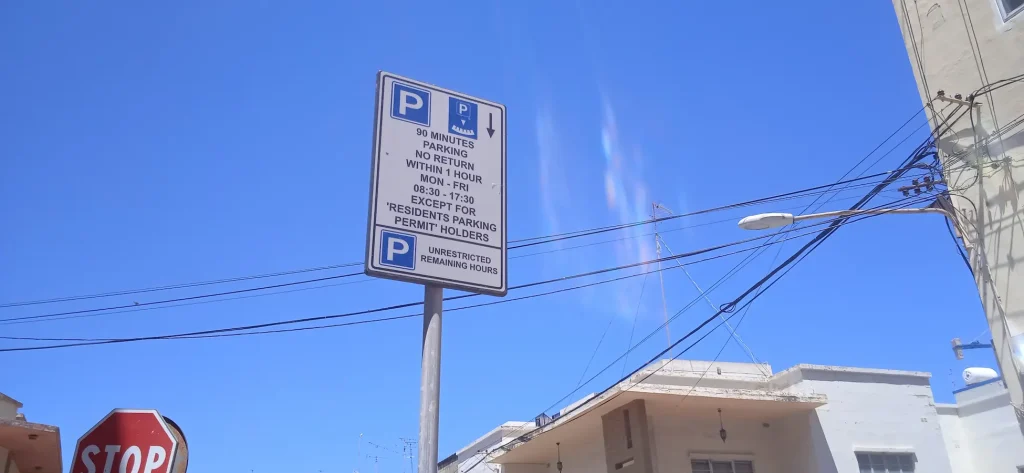
- Blue lines indicate paid parking (usually max. 2 hours). You must set your arrival time on the parking disc placed in the lower left corner of the windscreen and follow the limit shown on the additional sign. In blue zones, the parking disc is not replaced by a ticket from a machine — you must manually set the arrival time. An incorrectly set disc is treated as a breach of the rules.
- Yellow lines mean no stopping, often near junctions, driveways, or garages.
- Green lines mark spaces for residents with a valid permit.
Because Maltese streets are often very narrow, locals fold in their wing mirrors when parking to avoid getting them clipped — a good habit worth adopting.
Valletta entry charge (CVA – Controlled Vehicular Access)
Driving into Valletta’s city centre is subject to the CVA charge, calculated based on the actual time spent within the zone. The first 30 minutes are free, after which you pay €0.82 for each started hour, with a daily cap of roughly €6.52. The charge applies Monday to Friday between 08:00 and 14:00.
After these hours, and on weekends and public holidays, entry and parking are free. Outside the chargeable times, the fee does not apply, but normal parking rules still do. The system is electronic — cameras read your number plate and the amount is automatically billed to the vehicle owner. With a rental car, the charge will be passed on to you by the rental company later.
Where to park in Valletta and Floriana (practical tip)
Outside the historic core, you can also park along the waterfront in white zones (free). However, these spots are often full — finding a space is often a matter of luck.
Want certainty and don’t want to waste time circling around Valletta or Floriana? Use the paid MCP Parking Garage right by the roundabout at the turn from Floriana into Valletta. Prices are roughly €3 for the first 45 minutes, then €0.60 for each additional hour.
At some car parks you may come across local “attendants” who unofficially help direct parking, point out where to stop, and sometimes even assist with manoeuvring in tight spaces. They often have a good sense of where a spot is about to free up on an otherwise full car park, or where you can still “squeeze in” without blocking traffic.
This is not an official city service and not a paid car park, but a small contribution is usually expected — typically around €1. The amount isn’t fixed and depends on the location and how much help you received. Think of it as part of the local character: a euro in your pocket can save you an awkward moment, and sometimes needless circling. If you decide not to give anything, there’s no legal penalty — but you might be treated to a short, loud “performance” for the audience on the car park.
Pulling out of parking spaces in Malta: why drivers rarely give way
When reversing out of a parking space, be extremely cautious. Even if half your car is already in the traffic lane, most drivers will simply drive around you without hesitation — the more “considerate” ones will add a horn to let you know they’re there — and keep going. Don’t expect automatic courtesy or right of way when you’re pulling out.
Pedestrians and pedestrian crossings: why it’s better to slow down more than you’re used to
Assume that pedestrians often step into the road even away from marked crossings, and drivers do not automatically stop for them. As a driver, however, you are required to be maximally cautious — in the event of a collision, responsibility often falls on you.
Driving in the rain
After the first rain following a long dry spell, roads can be extremely slippery — dust and oils linger on the asphalt and water turns it into a skating rink. Paradoxically, the first half-hour of rain is the most dangerous, especially on bends and roundabouts.
Malta doesn’t have a continuous, systematic network of road drainage channels like you may know from continental Europe. Water runoff is therefore handled only locally in places (grates, culverts, natural slope), but often it’s missing entirely, especially on older or secondary roads. During heavy downpours, water has nowhere to go — slippery pools form, and in some places you must drive slowly and quite literally wade through a continuous sheet of water.
Traffic cameras and fines in Malta: how it works in practice
Malta has a network of fixed and mobile cameras that monitor speed, red-light offences, and entry into restricted zones. You won’t be fined on the spot — the notice often arrives by post days or weeks later, or it may be charged on by the rental company. Unpaid fines can increase with administrative fees, but if you’re convinced you received a fine unfairly, paying it online automatically counts as accepting it. You’ll find how to challenge a fine in the related article.
Related article: Traffic fines in Malta — how to check, pay or challenge them
Navigation in Malta: why Google Maps isn’t always reliable
Navigation (Google Maps, Waze) is helpful in Malta, but not infallible. It can send you into one-way streets (which do change from time to time), extremely narrow lanes, or dead ends. If you’re unsure, follow the local road signs and return to the main road.
What to do after a road accident in Malta (especially in a rental car)
In a rental car, you’ll usually find contact numbers for emergencies. Most rental companies also require you to report any incident immediately, and their representative will often come to the scene — even if it’s “just” a scratch. Without notification, your insurance cover may be disputed.
THREE COMMON WAYS ACCIDENTS ARE HANDLED IN MALTA:
- For a simple rear-end collision (“front-to-rear”) with no injuries, you typically complete a “front-to-rear” form. You’ll often find it in the glove compartment, or the rental company can provide it. After filling it in and sketching the damage, you move the vehicles out of the traffic lane and there is no need to call the police or LESA.
- If it’s a more complex accident (e.g., side impact, unclear fault, multiple vehicles, refusal to cooperate), call LESA on 2132 0202. LESA will send an officer who documents everything — takes photos, writes a report, and may call the police or a tow truck if needed. Note: in Malta, in most cases accidents are not handled by the police, but by LESA.
- Call the police (112 or 2122 4001) only in specific cases: if there are injuries, one party leaves the scene, there is damage to public property, or aggressive behaviour occurs. Otherwise, you’ll typically be referred back to LESA.
What is LESA? LESA, the Local Enforcement System Agency, is a government enforcement agency responsible for enforcing local regulations, including traffic offences and other areas such as parking, waste, and public order. It functions similarly to municipal police — issuing fines, monitoring compliance with local bylaws, and formally documenting traffic incidents.
When dealing with LESA or the police, I recommend insisting on communication in English. Locals often switch into Maltese between themselves, which can create confusion about what is recorded in the report. Especially with older scratches on the vehicle, be careful they are not attributed to you. After an accident, document everything — ideally photograph the damage, number plates, nearby road signs, and the overall context. Always contact your rental company and follow their instructions; they often want to be informed as early as possible, and their representative can handle many things for you.
Summary: how to drive calmly and avoid unnecessary problems
Driving in Malta can feel a bit stressful at first — left-hand traffic, narrow streets, and the energetic style of local drivers. But if you drive calmly, stay attentive, and don’t underestimate the choice of rental company and insurance, you’ll manage without trouble. A good navigation system, plenty of patience, and a sense of perspective are often more important than perfect car control. And if something goes wrong — stay calm. There’s a solution to everything. A car gives you freedom, so I definitely recommend renting one.
Related articles
- Malta Car Hire Guide: Everything You Need to Know Before Renting a Car
- Malta Public Transport: Bus Fares, Tallinja Card, Ferries & Travel Tips
- Taxis in Malta: Prices, Apps, Airport Pick-ups and Tips for Families and Pet Owners
- What to Do If Your Car Gets Towed in Malta
- Got a Traffic Fine in Malta? Here’s What You Should Do
- How to Get from Malta Airport (Luqa) to Sliema
Most common questions about driving and parking in Malta
Is it safe to drive in Malta as a tourist?
Yes — but it can feel intense if you’re used to calmer traffic. The key is knowing what to expect: driving on the left, narrow streets, and a more “improvised” local style. In the guide, I explain the situations that catch visitors out most often and how to stay calm.
Do I really need a car in Malta, or is public transport enough?
It depends on your plans. A car gives you freedom for beaches, viewpoints, and late evenings, but parking and city traffic can be stressful. If you’re mostly staying in busy areas, buses and taxis can be enough. In the article, I break down what makes sense for different types of trips.
What should I check before renting a car in Malta (insurance and deposits)?
Focus on the excess, what counts as “damage”, and how deposits are handled. Minor scratches are common on the island, so the contract details matter more than the headline price. The guide explains the usual pitfalls and what to photograph before you drive off.
What should I do if I have a minor accident in Malta (especially in a rental car)?
Don’t panic — the procedure is often different from what visitors expect. Many non-injury accidents are handled without the police, and getting the steps right matters for insurance and rental liability. In the guide, I outline the typical scenarios and who to call.